NATIONAL ORGANIZATION FOR THE REFORM OF MARIJUANA LAWS

1001 CONNECTICUT AVENUE NW
SUITE 1010
WASHINGTON, D.C. 20036

T 202-483-5500 • F 202-483-0057 • E-MAIL NATLNORML@AOL.COM
Internet
http://www.norml.org
. . . a weekly service for the media on news items related to Marijuana Prohibition.

March 27, 1997

Oklahoma Legislature Ready To Approve Aerial Spraying Of Controversial Anti-Marijuana Herbicide

March 27, 1997, Oklahoma City, OK:  Legislation that would allow law enforcement to spray the herbicide glyphosate (brand name: "Round Up") from low-flying helicopters on wild marijuana crops appears on its way to becoming law in Oklahoma.  The bill was overwhelmingly passed by the House and Senate Agriculture Committee despite testimony and heavy campaigning from Oklahoma NORML activists who introduced evidence indicating several potential health and environmental hazards posed by the chemical.  The full Senate is expected to approved the bill shortly.
"I have [recent] documentation from a doctor in Hawaii detailing scores of complaints from residents due to this herbicide being sprayed aerially," testified Oklahoma NORML President Michael Pearson.  "A mistake such as this [must] not happen ... in Oklahoma."
Pearson referred to several scientific and anecdotal reports linking glyphosate spraying to various illnesses.  Most recently, a physician in Hawaii -- Dr. Patricia Bailey -- collected incident reports from some 40 persons, ages nine months to 84 years, who claimed to have contracted flu-like symptoms such as nausea and headaches shortly after aerial marijuana-eradication efforts were conducted on the island.  Additional reports of alleged glyphosate-related hazards such as dead wildlife were reported by local Hawaiian television station KGMB and in the Hawaii Tribune-Herald.
Bailey and Pearson's concerns echo statements made in several environmental publications over the last few years.  For example, a report in the February 1993 issue of Global Pesticide Campaigner called marijuana eradication efforts using glyphosate in Colombia "unsuccessful" and highlighted the chemical's potential dangers.  "Reports from other countries where aerial spraying has been used in anti-drug programs are not encouraging," states the article. "International health workers in Guatemala report acute poisonings in peasants living in areas near eradication spraying, while farmers in these zones have sustained serious damage to their ... crops."
Closer to home, residents in California have also complained of glyphosate exposure, according to an article in the winter 1995 edition of the Journal of Pesticide Reform.  It states: "In California, the state with the most comprehensive program for reporting pesticide-cause illness, glyphosate was the third most commonly-reported pesticide illness among agricultural workers.  Among landscape maintenance workers, glyphosate was the most commonly reported cause."  The article also called aerial movement of the chemical through unwanted drift "unavoidable."
Presently, there are numerous 100-acre patches of wild marijuana growing in Oklahoma.  The marijuana is left over from government-subsidized plots grown during World War II when low-THC strains of the plant were harvested for their fiber content.  Commonly referred to as industrial hemp or "ditchweed," this strain of marijuana will not get users "high" when inhaled.
The bill's sponsor, Rep. Danny Hilliard (D-Sulfur), declared that passage of the legislation is "necessary for the preservation of the public peace, health, and safety."  Law enforcement currently conduct state marijuana eradication efforts on foot using portable glyphosate sprayers.
For more information on the use of glyphosate in marijuana eradication, please contact Paul Armentano of NORML @ (202) 483-5500.  For more information on H.B. 2116, please contact Michael Pearson of Oklahoma NORML @ (405) 840-4367 or via e-mail at: Oknorml@aol.com.  Rep. Danny Hilliard may be reached at (405) 521-2711 or by writing to the Oklahoma House of Representatives at: 2300 North Lincoln St., Oklahoma City, OK 73105-4885.

Hearing Held In Case Of Arkansas Couple Extradited To America To Face Marijuana Cultivation Charges

March 27, 1997, Little Rock, AR:  A hearing was held on March 20 in the case of Cheryl and Les Mooring, an Arkansas couple who had been extradited last January after fleeing the United States for Holland in 1994 rather than face federal charges for marijuana cultivation.  It is speculated that the Moorings are the first Americans to be successfully extradited from Holland by the United States government to face marijuana charges.
Evidence was entered by the defense alleging that the Drug Enforcement Administration (DEA) violated the Moorings Fourth Amendment rights by gathering evidence without a search warrant, explained NORML Amicus Curiae Committee Co-Chair Michael Cutler, Esq., who defended Mrs. Mooring pro bono.  After reviewing this evidence and the defense's motion to suppress, the prosecution conceded that the Fourth Amendment issue should be examined further and that Cheryl Mooring played no significant role in her husband's marijuana cultivation.  The prosecution's admission marked a victory for Ms. Mooring and allowed to her to plead guilty to a lesser charge of "misprison of a felony" (failing to turn in someone whom she knew was committing a felony) for which she was immediately released from jail.  No escape charges will be brought against Ms. Mooring.
Mr. Mooring's guilty plea to the marijuana charges carries a ten year mandatory minimum prison term.  However, the defense negotiated an unusual provision allowing him to withdraw his plea if the suppression motion is eventually granted by the trial or appellate court.  If the courts decide the search was illegal, he will be released.
Mr. Mooring claims that he uses marijuana to treat chronic pain.  Cutler praised the dismissal of Cheryl Mooring's drug charges as a "tribute to NORML's advocacy."  He further acknowledged the "moderate views" of the trail judge, and most importantly, the Assistant U.S. Attorney "who recognized the injustice of subjecting Cheryl to federal drug law sentencing."
Cutler notes the Mooring case clearly illustrates the insanity of the drug war.  "The idea that the federal government would engage in a year-and-a-half battle against Dutch opposition to extradite this couple in an effort to keep children drug-free is absolutely ridiculous," summarized Cutler.
For more information, please contact attorney Michael Cutler @ (617) 439-4990 or Allen St. Pierre of NORML @ (202) 483-5500.

Hawaii Court Case To Argue For Religious Use Of Marijuana

Hawaii

March 25, 1997, Kealakekua, HI:  Jury selection was taken for an upcoming trial to determine whether smoking marijuana is a religious sacrament protected under the United States Religious Freedom Restoration Act of 1993.  This case will be the first argued since the Ninth Circuit U.S. Court of Appeals ruled that Rastafarians can defend themselves against charges of marijuana possession on religious grounds.
The defendant in the case, the Rev. Dennis Shields, is a minister in the Religion of Jesus Church and claims that the use of marijuana is a sacrament in his church.  He was charged with misdemeanor possession of a detrimental drug in 1994 after police found several ounces of marijuana at his home.  Shields has been a long-time member of the church, which was founded nearly three decades ago.
The Religious Freedom Restoration Act of 1993 strengthened protections for religious groups and was intended to curb criminal prosecutions that interfere with religious beliefs.  Congress passed the law after an Oregon court ruled that Native Americans had no right to use peyote during religious ceremonies.  The act requires the government to show a compelling interest for any prosecution that significantly hinders the exercise of religious freedom.
For more information, please contact the Rev. Dennis Shields @ (808) 328-9794 or Allen St. Pierre of NORML @ (202) 483-5500.

-END-

MORE THAN 10 MILLION MARIJUANA ARRESTS SINCE 1965 . . . ANOTHER EVERY 54 SECONDS!

© copyright 1997 NORML NORML Home Page comments: norml@natlnorml.org

Regional and other news


Body Count

Only one of the four felons sentenced by Multnomah County courts in the most recent week received jail or prison terms for controlled-substance offenses, according to the "Portland" zoned section of
The Oregonian, ("Courts," March 27, 1997, p. 8, 3M-MP-NE). That makes the body count so far this year 52 out of 111, or 45.94 percent.


Industrial Hemp Bill Introduced To Oregon Legislature

Rep. Floyd Prozanski, D-Eugene, has sponsored House Bill 3623, which would bring industrial hemp to Oregon.
The summary of HB 3623 reads: "Permits growing of industrial hemp. Provides for State Department of Agriculture to administer licensing and inspection program. Provides for civil penalties."
Industrial hemp would be subject to regulation by the State Department of Agriculture, and all growers or handlers of hemp would have to obtain a license.
The full text of the bill can be found on the state's Web server at http://www.leg.state.or.us/bills.html.
Toll-free calls to the Capitol switchboard in Salem can be made by dialing 1-800-332-2313. Call your legislator today to ask him or her to support HB 3623.


Call To Action - Drug Warriors March On Salem

The 69th biennial Oregon Legislature is in session and several bills to increase the harm associated with marijuana use have been introduced by misguided legislators. Please review the ensuing proposed legislation and contact your state representative and state senator and urge them to vote appropriately. Toll-free calls to the Capitol switchboard in Salem can be made by dialing 1-800-332-2313.
The most effective way to communicate with legislators is to politely state your opinion about a particular bill, which you should refer to by the number indicated in the text below. Call today!
To keep abreast of new developments go to
http://www.leg.state.or.us/bills.html and click on "Search Legislative Measures," then type in "marijuana" or whatever in the search index. Or click on "New Measures" or "Search by ORS/Measure Number," depending on your needs.
  • HB 3643 - A recriminalization bill introduced in the House. The summary reads, "Enhances penalty for possession of less than one ounce of marijuana. Provides that driving privileges of person who chooses not to agree to diversion agreement, or who fails to complete diversion agreement, are suspended for six months." HB 3643 also goes to great lengths institutionalizing expensive "diversion" programs. This measure has lots of sponsors from both houses, including representatives Minnis, Westlund, Carter, Courtney, Deckert, Harper, Lewis, Lokan, Markham, Milne, Roberts, Simmons, Snodgrass, Sowa, Starr, VanLeeuwen, Watt and Welsh; and senators Derfler, Ferrioli, Fisher, George, Kintigh, Miller, Qutub, Shannon, Stull and Tarno. A senate version, SB 636, has the same language. Both would recriminalize possession of less than one ounce of cannabis. Both would also suspend for six months the driving privileges of people arrested for possession who failed to complete a diversion agreement, even in non-driving-related cases. Both would also suspend for six months the driving privileges of people convicted a second or subsequent time for cannabis possession. Soon to be known as the "Defund Public Education to 19th Century Levels" bill?
  • HB 3126 - Rep. Markham's bill would recriminalize possession of less than an ounce of cannabis by making it a Class A misdemeanor punishable by a "fine of at least $100 per gram and not to exceed total of $5,000." Currently, the penalty is a $500-$1,000 fine.
  • HB 2464 - This blatantly unconstitutional bill would require public school teachers to pay for their own mandatory urine tests as a condition of employment.
    (Thanks to Jack Bates, jack@europa.com, of Portland NORML for much of the above.)
    Another Capitol-watcher who prefers anonymity writes:
    "I just got official information about Shirley Stull's SB 1004. She's changed it into a ballot referral for the November 1998 election. The bill would: Increase possession penalties to ["not less than"] $100 per gram up to a maximum fine of $5,000 and even more heinously would make simple possession a felony with penalty up to a year in prison if busted within 1000 feet of a school. It's interesting that the bill seeks to put this ballot (on the ballot) at the same time that the pro-initiative would appear. I think you should include this item on your new release. Information is from the AP broadcast wire."
    The vast majority of territory in Portland and most other cities in Oregon probably lies within 1,000 feet of a school. The state's gopher says SB 1004 also creates the crime of "being under the influence." It is co-sponsored by senators George, Gordly, Kintigh, Miller, Qutub, Tarno, Timms, and Representative Milne.
    Sandee Burbank adds:
    >From The Oregonian, 2-19-97
    >
    >Bill Watch page C3
    >Bills introduced Tuesday in the Oregon Legislature include one to:
    >
    >Prohibit dispensing of methadone as a drug addiction treatment and bar the
    >state from participating in federal programs promoting methadone treatment.
    >HB2606 by Rep. Jim Hill, R-Hillsboro
    Other counterproductive proposals introduced so far include House Bill 3642, sponsored by representatives Minnis and Stull, which creates the "crime of being under the influence of a controlled substance. Punishes by maximum of one year imprisonment, $5,000 fine, or both. Provides for diversion on first arrest and for certain juvenile offenders. Requires minimum 90 days' imprisonment for first conviction. Requires Board on Public Safety Standards and Training to provide training to law enforcement officers regarding identification of persons under influence of controlled substances."
    Senate Bill 1060 not only creates the crime of BUI, it also makes it a felony to be "addicted to Schedule I controlled substance. Punishes by maximum imprisonment of six months, $2,000 fine, or both."
    This is "good government"? Until there is some requirement that sponsors of new drug-policy laws provide credible estimates of what a new statute would cost, and credible evidence that a new law would achieve certain specified goals, Oregonians will continue to fritter away their future on a utopian prohibitionist pipe dreams that only make all of our problems worse in every way.


    Eugene Hemp Company Raided - Owner Says He's Innocent

    "Company That Uses Hemp Raided By Oregon Police"

    The Associated Press, circa March 22, 1997
    EUGENE, Ore. - A business owner charged Friday that a police raid that netted drugs and cash is part of a vendetta against advocates of using hemp as an alternative to more traditional products.
    Todd Dalotto is founder of 3-year-old Hungry Bear Hemp Foods which distributes "Seedy Sweetie" energy bars and other hemp products around the country.
    "It's obvious that what this is about is bringing down the hemp movement and hemp activists," said Dalotto. He said the imported hemp seeds in his products contain none of the mind-altering substances in marijuana and maintains they have been cleared by the federal government.
    Guns drawn, Eugene police wearing helmets and carrying gas masks joined members of an interagency anti-drug team Thursday in a raid on a building housing the Hungry Bear offices and several other businesses.
    Police seized business records and computers from Dalotto's office, along with hemp seeds from his kitchen, where two employees were packaging "Seedy Sweeties" when police burst in.
    Also seized were two pounds of marijuana, a quarter pound of mushrooms and $5,000 in cash. Police spokeswoman Jan Power declined to say Friday whether the drugs and cash were found in Dalotto's space or elsewhere in the building.
    Dalotto was not arrested but two men who disobeyed orders to stay off the premises while it was searched were charged with trespass.

    [End of article]

    Todd Dalotto comments:
    Around mid-day on Thursday, March 20, 1997, the Eugene Police Department (with cooperation from INET) broke in the door at 302 Blair Blvd. with guns drawn on Todd Dalotto and two friends (who were peacefully listening to music and packaging Seedy Sweeties). After being cuffed for 15 min and refusing to speak, Dalotto, the owner of Hungry Bear Hemp Foods, was ordered to leave the building. The EPD spent the next three hours ransacking nearly every room on that side of the building.
    They seized at least 46 items including two computers, a Video Camera, artwork (from the soon to open hemp art gallery), hemp food, files, floppy disks and other things necessary for Hungry Bear to be in business.
    According to news and evidence reports the police also confiscated quantities of marijuana, mushrooms, and cash, none of which belong to Todd Dalotto. The only arrests were two men from COPWATCH (both tenants of the building), charged with 2nd degree trespass for being in their own backyard during the raid.
    One of the files seized contained documents from the "Vortex", a peaceful culture, music and performance festival in July, 1995 at Maurie Jacobs Park in Eugene, where the Eugene Police Department started a riot and pepper sprayed dozens of innocent adults and children while dragging Todd Dalotto violently by his hair away to jail for not taking down his Hemp Seed Smoothie Booth. This file is potentially incriminating to the EPD.
    It is uncertain at this point if the unrevealed intentions of the raid were to bury the Vortex evidence, or to just disable a business has been successful at furthering the hemp movement and related issues
    On the positive side, this incident is an indicator that Hungry Bear Hemp Foods is being effective in raising consciousness and appetites for this delicious, nutritious seed that the power structure wants to keep hidden. Widespread use of the highly nutritious hemp seed in our diets can cause a serious dent to the medical, pharmaceutical, and forensic drug lab industries (for more info on these subjects check out other writings by Hungry Bear). Well, another chapter in Hungry Bear's upcoming book...
    Please forward this...Those who feel they can be of serious help to Hungry Bear's case, please contact him:

    Todd Dalotto
    Hungry Bear Hemp Foods
    P.O. Box 12175, Eugene, OR 97440-4375 U.S.A.
    Tel: 541-345-5216 Fax: 541-302-1488
    http://www.efn.org/~eathemp/hbhempfood.html
    e-mail: eathemp@efn.org


    'Cannabis Culture Rally' April 4 In Eugene

    A benefit for Eugene's Cannabis Liberation Society begins 9 pm Friday, April 4, at John Henry's, 136 E. 11th Ave. in Eugene features live music and guest speaker Todd Dalotto. Organized by Big Green Productions, the benefit also features free door prizes for the first 30 patrons. Tickets are $5 singles, $8 couples and $9 for a group of three.
    The Eugene Cannabis Liberation Society hosts weekly meetings 6:30-8 pm every Wednesday. Every third Wednesday is Pot Luck. The next two CLS meetings will be April 2 and 9 at the University of Oregon in Century Room "A" of the Erb Memorial Union located at 13th Avenue and University Street.
    For more details call the CLS at (541) 744-5744


    Dog w/'Oregonian'

    That Incredible American Mass Media

    Many Americans believe the news media are inaccurate, intrusive and unfair, according to a survey by the Pew Research Center for the People and the Press. Fifty-six percent said news stories are filled with wrong information, and 67 percent said news organizations are often biased when reporting on politics and social issues. (Associated Press item in The International Herald Tribune, March 23, 1997)


    "The Drug Index"

    Playboy, September 1995
    • Number of Americans who have used illegal drugs in the past month: 11.7 million
    • Number of monthly users whose only illegal drug is marijuana: 9 million
    • Percentage of high school seniors who smoke marijuana every day: 4
    • Number of hash bars in the Netherlands: 2000
    • Percentage of Dutch teenagers who smoke cannabis products: 3
    • Percentage of Americans who would legalize marijuana possession: 40
    • Percentage of first-year college students who would legalize marijuana: 28
    • Number of federal prisons in 1982: 45
    • Number of federal prisons in 1995: 79
    • Annual cost to keep first-time nonviolent drug offenders in federal prisons: $320 million
    • Annual cost to keep noncitizens in federal prisons: $400 million
    • Number of Americans in need of treatment for drug abuse: 5 million
    • Number of publicly funded treatment slots available: 600,000
    • Increase in treatment budget requested by President Clinton in 1994: $355 million
    • Increase in treatment budget approved by Congress in 1994: $67 million

    Interesting Oregonian Quote From 1886

    "Of all serious crimes under the law, smuggling... least violates the consciences of men. It is a crime against law and against government, but not against morality. The smuggler robs no man. He buys goods honestly in one market and sells them honestly in another. His offense is against an arbitrary regulation of government.... he simply fails to pay its demands. Many men otherwise honest are unable to see any moral turpitude in smuggling. ...government, in exacting toll, plays the part of the highwayman."
    - editorial from the Portland Oregonian, Jan 21, 1886, page 2, titled "The Kaasan Bay 'Find'"

    Percentage Of States' Drug Arrests For Marijuana, 1988

    Over 10 Million The editor just spoke with a recent graduate of Multnomah County's work-release and restitution center at Southwest 11th Avenue and Main Street in downtown Portland. After six months, his firm estimate was that 20 percent of the inmates at the center were serving time for marijuana-related convictions, mostly cultivation.
    The next time a public official denies marijuana offenders are being locked up in significant numbers, show him or her the FBI statistics below. If anyone has seen an FBI report with numbers more recent than 1988, please send a copy to the editor.
    Found at gopher://hemp.uwec.edu:70/00/drugs/news/arrests:
    WASHINGTON (AP) - Here is a list of 48 states and the District of Columbia in order of percentage of drug arrests that concerned marijuana compared with total arrests for cocaine and opiates such as heroin. These figures are based on FBI statistics for 1988, the most recent year for which such a breakdown was available. Florida and Kentucky did not submit data. The numbers do not add up to 100 because they do not include synthetic narcotics and other drugs.
    [Rates for all the states and DC are included at the preceding URL. Ensuing are numbers for some Western states, including Oregon. One assumes not much has changed except maybe in California or Arizona. - ed.]
    
    State	    Marijuana     Cocaine-Opiates
    
    Idaho		79		14
    Hawaii		69		26
    New Mexico	68		19
    Alaska		61		24
    Utah		59		27
    Colorado	52		32
    Arizona..	51		29
    Washington	51		42
    Oregon		41		36
    Nevada		35		29
    California	13		70
    

    "A Devastating Illness Made Food Her Foe"

    By Paul Carpenter
    The Morning Call (Allentown, PA), March 23, 1997, p. B1
    In Case of Emergency Denise Smith was not especially surprised when her blood test came back positive. The father of her child, after all, died of AIDS. Nevertheless, it was devastating.
    "It was really hard, scary," she told me in her Monroe County home, accompanied by her present husband and her mother. The terrible news that she was HIV-positive came about six years ago. A couple of years later, she developed the first painful symptoms of full-blown AIDS.
    By last summer, Smith was in agony and her normally slim 5-foot-3 frame was starting to look skeletal.
    "Twenty pounds I lost! I'm back up to 100 pounds now, but I got down to 87," she said.
    Food became her enemy, causing almost immediate vomiting or diarrhea. Along with other wretched maladies associated with AIDS, she was starving to death.
    "We tried everything to keep (the food) down, and nothing helped," Smith said, referring to nausea and diarrhea medications, including Zofran, prescribed by doctors.
    "I was afraid to eat. Every time I eat, up it comes or out it comes. ... I thought, oh, I was dying."
    She also suffered from high fever, weakness, dizziness, hair loss and horrible reactions to prescription drugs, especially those to treat MAC, a disease similar to tuberculosis and common in advanced AIDS cases.
    Then Smith tried marijuana, and she was able to eat again. It also seemed to help her sleep better and to lessen her awful nightmares.
    Now, Smith uses the equivalent of about two marijuana cigarettes a week, and that's enough to get her appetite back and to keep the food in her stomach. She smokes a pinch of pot at a time in a little pipe. Why, I asked, are you telling me all this? Aren't you afraid of getting in trouble with the law?
    "Not at all," she said. "I don't see myself as being a criminal. It (pot) makes me feel better. I know it's illegal, but it makes me feel better."
    At that point, her husband, Al Smith, spoke up in response to her acknowledgment that pot is illegal. "So was harboring slaves," he noted.
    He did not come by such attitudes on an ad hoc basis. Apart from wishing to ease his wife's suffering, he twice ran for Congress as the Libertarian Party candidate challenging U.S. Rep. Joe McDade. (The Libertarians oppose our draconian drug laws, along with any other law that lets authorities intrude into personal behavior that's not harmful to others.)
    Anyway, Al Smith, who works as a carpenter, has formed an organization to fight for the legalization of the therapeutic use of marijuana. He calls it Dee's Dream (Denise's nickname is Dee) and the address is P.O. Box 41, Analomink, PA 18320. E-mail can be sent to alsmith@bigfoot.com.
    I know what you're thinking. You saw the story in the paper last month. It said area doctors see no need to prescribe marijuana, because other medications work just fine.
    Some doctors, the story said, suspect "ulterior motives" behind the legalization philosophy. "The people who want this are, frankly, potheads," Allentown eye surgeon Harold Goldfarb was quoted as saying.
    I, frankly, should like to see if Goldfarb has the guts to look Denise Smith in the face and say that. And speaking of ulterior motives, how much money will the medical establishment make if people are allowed to use something that is effective, does not come in a pill, and cannot be controlled through prescriptions? The prescribed medication Smith was given to ease some of her most gruesome symptoms is Zofran, which costs $10 per pill. She had to take three pills a day, and it didn't work nearly as well as marijuana.
    The legal system often makes people suffer, but nowhere more unjustly than here. I'll get to some of the legal questions at another time. For now, the key question is this:
    If you were in Denise Smith's place, vomiting every bite of food you tried to swallow and down to 87 pounds, what would your philosophical position be then?


    Anguished Advocate Crusades For Legal Pot in Maine

    "Anguished Advocate Crusades For Legal Pot;
    Bryan Clark Doesn't Want To Break The Law To Survive"

    Portland Press Herald, March 23, 1997, p. 1B
    by Joshua L. Weinstein, Staff Writer
    Bryan Clark has taken all kinds of medicine in his 23 years.
    When he was an infant, doctors pushed needles into the tiny veins of his head and injected drugs to keep the young hemophiliac from bleeding to death.
    They've since prescribed him addictive narcotic capsules and powerful antibiotics. They've given him drugs that made him urinate blood. That made him dizzy. That made him vomit.
    Yet they cannot give him the drug he says he needs the most - not legally, at least. They cannot give him marijuana.
    Clark smokes anyway. It's the only thing that quells the nausea that torments him always. Without marijuana, he says, he cannot bring himself to eat.
    So at 23 years old, Bryan Clark figures he has three choices: break the law, change the law or die. Clark is a survivor. He has had hemophilia his whole life and the virus that causes AIDS for more than 10 years.
    He's trying to change Maine's law.
    At Clark's urging, State Sen. Anne Rand, D-Portland, has introduced a bill that would legalize marijuana for medicinal purposes. State Rep. Kathleen Stevens, D-Orono, has introduced a similar bill. Members of the Legislature's Joint Standing Committee on Health and Human Services are considering both.
    The issue is drawing national attention to Maine, particularly because voters in California and Arizona approved medical marijuana measures during last November's elections. Maine's experience is similar to California's. Both state legislatures have passed medical marijuana laws, and both were vetoed. California's Republican governor, Pete Wilson, vetoed that state's bill in 1994 and 1995. Maine's former governor, John McKernan, also a Republican, vetoed one here in 1991.
    Maine Gov. Angus King, the nation's only independent governor, said he is "skeptical but open-minded" about the bill. His administration expressed lukewarm opposition, but he said he is unlikely to veto a tightly written bill.
    After last November's election, the federal government announced plans to spend $1 million and 18 months surveying old studies of marijuana's medical utility.
    Clark is unimpressed. He calls the federal survey a book report.
    He wonders whether he has 18 months.
    The winter chill gnaws at Bryan Clark's arthritic elbows and ankles, so he keeps the suburban Portland apartment he shares with his fiancee unusually warm.
    Despite its cold concrete slab floor, the apartment is a pleasant place, where a black housecat named Floyd keeps a wary truce with an iguana named Jazzy.
    The apartment is quintessential suburban Maine. A snowman stands guard outside, and family pictures and knick-knacks grace the walls.
    But it's not all Ozzie and Harriett.
    The tin on the coffee table - the one that used to contain Sleepy Time Herb Tea - is now full of marijuana.
    As far as Clark is concerned, the marijuana is medicine. He believes he'd be dead without it.
    He said he almost was.
    Clark explained that he was chunky as a kid. Fat, even. When he was 16, the 5-foot-10 Clark weighed 240 pounds.
    In September 1992, shortly after he turned 17, Clark caught the flu and began losing weight. Soon, he was shedding pounds uncontrollably, spiraling into what's called "wasting syndrome." By April 1993, he was down to 118 pounds.
    His family thought he was going to die.
    When he smoked marijuana, though, the relief was immediate. He could think about food without retching. He could keep food down.
    He started gaining weight.
    And he has smoked ever since, to moderate his nausea.
    "My nausea, that I feel 24 (hours a day,) 7 (days a week) is like a normal person with hunger pain and heartburn," he explained. "Don't eat for four days, drink a cup of black espresso with no sugar. That's about how I feel. Minus the caffeine buzz.
    "You know how you wake up and feel hungry, and you go back to sleep, and you wake up again and you're not hungry anymore, you're just tired, and hollow? If you don't eat anything by 2 or 3 o'clock, you get this deep, bending stomach nausea. That's how I feel." As he spoke, he extracted a rolling paper from a pack of Jokers, and filled it with marijuana. Nimbly, he rolled a perfect joint, and took a puff.
    It was after 2 p.m., and he hadn't eaten all day. He had swallowed two Tylox the night before, and was still haunted by a narcotic hangover.
    A few puffs and seconds later, the nausea was gone. Clark acknowledged a pleasant buzz, but he remained coherent.
    Others less effective
    He said his other anti-nausea medicines are far less effective.
    "This is Marinol," he said, holding up a bottle of 100 orange pearls that look like fish eggs.
    Marinol is synthetic THC - delta 9-tetrahydrocannabinol - which scientists say is the active ingredient in marijuana. It is to cannabis what vitamin C tablets are to oranges. A bottle of 100 costs $1,521.98. Clark pays $3. Medicaid pays the rest. But Clark said the legal drug is no good.
    It's hard to swallow medicine when you're nauseated, he explained. Even if Clark can keep the medicine down, he must wait about a half-hour for it to take effect.
    Then, the nausea subsides somewhat. But unlike smoked marijuana, Marinol renders Clark profoundly, uselessly stoned, and keeps him that way more than five hours.
    With smoked marijuana, he can control the dose. The nausea vanishes almost immediately, and the high diminishes within two hours. Although he cannot drive, he can function around the house.
    Most importantly, Clark can eat.
    He breaks the law to do so.

    'Yes, you do have HIV'

    Fifteen years ago, Bryan Clark sat cross-legged in front of his television set at his boyhood home in Andover, watching a Cable News Network report about U Portland Press Herald March 23, 1997, Sunday, a new illness called AIDS.
    "That's what I'm going to die from," Clark, then 8 years old, told his mother.
    "No, Bryan, you're not going to die of that," Linda Clark remembers soothing her son. "You'll probably never get it."
    The child was insistent, his mother recalls. "He said, 'Mommy, that's what's going to take me and all of the other hemophiliacs. You just watch.' "
    Five years later, Clark was at Maine Medical Center, suffering from a bleed in his hip. His doctor called him into a conference room.
    "We drew you and checked," the doctor said, referring to drawing Clark's blood. "Yes, you do have HIV. Do you have any questions."
    Only seven months earlier, one of Clark's friends, another hemophiliac, had died from AIDS.
    Clark was born with hemophilia, a hereditary bleeding disorder that means he lacks one of the factors that makes blood clot. Hemophiliacs' blood is as thick as anyone else's. It just doesn't clot as easily. Sometimes it doesn't clot at all. Instead of developing annoying bruises when they bump into something, severe hemophiliacs get dangerous, painful internal bleeds.
    To stop the bleeding, they inject anti-hemophilic factor, which makes their blood clot.

    HIV is passed along

    In the 1970s and early 1980s, the anti-hemophilic factor that Clark and nearly every other hemophiliac shot into their veins was contaminated with HIV, the virus that causes AIDS.
    Within years, almost all hemophiliacs would be sick or dead, their very lifeblood poison.
    Even without AIDS, severe hemophiliacs lead difficult lives. They act the same as other little boys. (Girls do not get classic hemophilia.) They run around. They climb trees. They also get hurt more easily than other children. Clark woke up every morning wondering what kind of pain he'd be in by the end of the day. Knowing he might be injured before nightfall, he'd squeeze as much fun as possible into each day.
    Every few months, he'd get hurt and his parents would rush him to the hospital for a shot of clotting factor.
    The combination of hemophilia and AIDS is especially brutal: At one point, Clark's violent, AIDS-related vomiting caused hemophilia-related internal bleeding.
    The prejudices of others, as well as the caprices of genetics, also sting.
    A junior high school teacher berated him when he refused to write a paper about his plans for the future.
    During his early years as an HIV-positive adolescent, Clark figured he didn't have much of a future.
    But eventually he found a future, and a calling, in marijuana.

    'Idealistic and innocent'

    Bryan Clark had faith in the Legislature.
    He figured if he explained he was sick, and that marijuana made him better, his senators and representatives would change the law and let him have the drug.
    In 1994, at the age of 21, he called state Sen. Anne Rand and told her so. Rand was impressed with the young man and agreed to sponsor legislation. Clark traveled to Augusta to testify in favor of it.
    "I was so idealistic and innocent as far as the political system," he said. "On testimony day there were some tears shed, there was emotion, every member of the committee sat there and cried in their coffee cup on how they could help us, felt bad for us. We had the Maine AIDS Alliance in full support. We had support from all over."
    The bill was withdrawn after McKernan threatened a second veto.
    "I was surprised," Clark said. "I was angry. I was hurt." He was not deterred.
    "Every winter and spring he tries really hard to get the bill passed," said John Creelman, a longtime friend who met Clark when the two were children at the hemophilia clinic at Maine Medical Center.
    "That's what's driving him - to give these people the faith, to make them see the light. Every year he fails he goes home and stocks up more and more and more paperwork to go back and hit them harder."

    Information stacks up

    The paperwork Clark has amassed is impressive and organized. Mention an article about medical marijuana and Clark will pull it from an accordion file. Ask him about a study and he'll retrieve it.
    His knowledge and candor - he acknowledges being arrested on marijuana charges when he was 17, only to have the charges dropped after explaining he needed the drug for medicinal purposes - have impressed legislators.
    This year was the third year he spoke to lawmakers. By now, he knows the procedure. He pulls his usually unruly hair into a tidy ponytail and sticks to the point. He does not show his fear that every time someone coughs or sniffles, the germs will make their way to his compromised immune system.
    Members of the Health and Human Services Committee dab at their eyes as he speaks. They almost unanimously agree he should have the drug and that arresting him would be unjust.
    But they haven't been able to agree on how to help him.
    They argue about what kind of message legalizing marijuana for people like Clark would send to children. They haggle over nuance.
    They worry about the side effects of marijuana. They do not mention that the side effect of Clark's clotting factor - a legal drug, approved by the Food and Drug Administration - was AIDS.
    Legislators say they wish they could help him, yet they ignore him during workshop sessions.
    Clark, meanwhile, worries. "Everybody says, 'Why don't you just shut up, disappear, grow your pot and you will never be bothered?' I say I can't do that.
    "I already have to live in paranoia and fear of germs and other people's illnesses and sicknesses. I'm just a sponge for bacteria. I don't want to worry not only am I going to catch a cold at Rite Aid that will kill me, but that the police will come in and bust me and put me in jail. I'm staggered by the thought of what I could catch in prison."

    Doctors duel

    Clark's doctor, Marjorie A. Boyd of Portland, supports her patient.
    "His use of alternative therapies (in particular, cannabis) appear to be helping in the management of his disease," she wrote in a Feb. 4 letter. "It would be foolish not to recognize that these patients use these medications with good results. They do not abuse these compounds and are quite responsible, not only in their own use but in educating others to safe practices."
    John P. Morgan, a physician, professor at the City University of New York Medical School and member of the board of directors of the National Organization for the Reform of Marijuana Laws, told Maine lawmakers this month that marijuana is "a quite, quite good drug."
    The medical community is, however, divided on the matter.
    Robert DuPont, the first director of the National Institute on Drug Abuse and the nation's drug czar under Presidents Nixon and Ford, remains dubious.
    While DuPont said during an interview last week that he sympathizes with Clark, he does not believe marijuana has helped the young man.
    "What happens when you get a particular patient like this guy is he can be doing anything and perceive it as vital to his well-being. Medicine does not work on anecdotes," DuPont said.
    "The history of dealing with serious illnesses is replete with testimonials of people who can explain how their cancer was cured - or whatever else it was, was cured - by whatever.
    "Many fraudulent cures are supported by a great abundance of testimonials."
    DuPont calls medicinal marijuana a fraud. "There is no reason to believe that smoking - burning leaves - is an appropriate medical treatment in the final decade of the 20th century in the United States. It's just stupid."
    The wave, though, even among physicians, is going the other way.
    The New England Journal of Medicine, in an editorial in January, endorsed the use of marijuana for medicinal purposes. The Massachusetts Health Department this year embraced the concept.
    Other states are irrelevant to Clark. He, like his parents, their parents and their parents, was born in Maine.
    He is looking to this state's Legislature for action.
    Members of the Health and Human Services Committee plan to meet Monday to discuss the issue.
    Clark had an appointment with his doctor Monday. His condition has worsened, and he's supposed to begin a new course of medications. He has rescheduled the doctor's appointment.
    Instead, he'll be in Augusta.


    Maine Medical-Marijuana Initiative Under Way, More To Come?

    "Backers Of Medicinal Marijuana May Put Question To Voters"

    Portland Press Herald, March 23, 1997, p. 12B
    By Joshua L. Weinstein, Staff Writer
    AUGUSTA - If the Legislature does not legalize marijuana for medicinal purposes, advocates of the drug are prepared to ask voters to do it.
    That's what happened in Arizona and California, where voters last November passed medical marijuana laws.
    California Gov. Pete Wilson, a Republican, twice vetoed medical marijuana laws before voters approved it last year. Maine's former governor, John McKernan, also a Republican, vetoed a measure here in 1991.
    Medical marijuana advocates across the country have noticed the parallel, and may target Maine soon.
    "We have announced we're going to support local efforts in three to six states in 1998," said Dave Fratello, of Americans for Medical Freedom, the organization that sponsored California's initiative. "We're monitoring the situation in Maine."
    He explained that his group, which receives financial support from George Soros, a billionaire originally from Hungary, is targeting an East Coast state, and that Maine is one of the few that permits citizens to place questions on the ballot.
    Medicinal marijuana advocates in Maine are considering similar actions.
    Maine Citizens for Medical Marijuana, an offshoot of the Maine Vocals, already has begun a petition drive to place a question on the ballot legalizing marijuana for medicinal purposes.
    Bryan Clark, a 23-year-old Maine man who uses marijuana to combat the nausea caused by AIDS and has testified before the Maine Legislature about the issue three times, said he hopes lawmakers approve the measure before the voters do.
    But if the question ends up before the voters, Clark is ready to work for its passage.
    "I know I could get a public initiative through," said Clark, who contracted the virus that causes AIDS from contaminated blood in the medicine he uses to control his hemophilia.
    Rand Martin, chief of staff to California state Sen. John Vasconcellos, who sponsored the legislation that Wilson vetoed, said laws written by legislatures are generally better than ones generated by citizen initiative.
    But, he said, the people sometimes have to take the lead.
    A February poll commissioned by the Lindesmith Center, a New York-based marijuana advocacy organization which also receives money from Soros, found that 60 percent of Americans favor allowing doctors to prescribe marijuana for medicinal purposes for seriously ill patients.


    Iowa House Reviews Medical-Marijuana Bill

    [Note last sentence, about THC killing herpes virus. - ed.]

    "Medical marijuana also surging"
    Iowa State Daily, March 21, 1997, p. 1
    By Jonquil Wegmann
    Daily Staff Writer
    Amid the political controversy surrounding medicinal marijuana legalization in California and Arizona, the Iowa House is reviewing a bill calling for research of the medical merits of the plant.
    State Representative Ed Fallon introduced the bill, calling for research at the University of lowa. Now six Republicans and seven Democrats in the Iowa Senate say they support changes in law to prevent the arrest and prosecution of medicinal marijuana users. Ten Republicans and nine Democrats in the Iowa House support changes.
    Carl Olsen, of Iowa's NORML chapter, is working on behalf of Iowans for Medical Marijuana to reclassify marijuana as a drug to permit its medical use.
    "The main reason it should be legalized is because it's cruel and inhuman to put people in prison and jail for trying to relieve their pain," Olsen said.
    Olsen said the issue is not whether marijuana has medicinal use - he concedes it needs more research - but that sick people are being denied relief. Numerous medical and scientific associations, journals, researchers and practitioners have said marijuana has at least some medical validity.
    It has been found to reduce seizures of epileptic patients, nerve disorders of multiple sclerosis, nausea of cancer patients, eye pressure of glaucoma patients and can also thwart the waste syndrome of AIDS patients.
    For the past 10 years in Iowa, THC, the psychoactive medicinal component of the marijuana plant, has been available in a pill form cailed Marinol. However, patients complain it is too strong and too expensive - nearly $5 per pill. They say they cannot control the dosage.
    Researchers believe marijuana may have about 40 chemical components of therapeutic value. Unlike THC, many of these chemicals are reported to have no psychoactive effects.
    Among other medical uses, a recent study in Florida showed that THC placed in a test tube with a herpes virus killed the virus.


    "Court Eyes No-Knock Cop Entries"

    By Richard Carelli
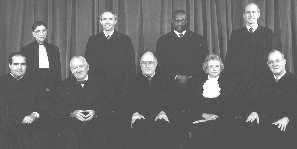
    Supremes WASHINGTON (AP, March 24, 1997) - The Supreme Court seemed to give serious consideration Monday to letting police enter homes without announcing themselves if they have court warrants to search for drugs.
    In a lively debate over a Madison, Wis., drug raid, the court contemplated creating a blanket exception to its 1995 ruling that said no-knock entries usually are unlawful.
    Justice Anthony M. Kennedy noted that the court recently ruled that police officers can, if they deem it necessary for self-protection, order all passengers out of vehicles stopped for routine traffic violations.
    "Isn't this just as sensible?" he asked about allowing no-knock entries.
    But some justices wondered aloud whether such an exception would swallow the 1995 rule. "Aren't we just gutting what we said a couple of years ago?" Justice Ruth Bader Ginsburg asked.
    While it was clear the court does not want to endanger officers' lives unnecessarily, the justices voiced frustration about the lack of statistical guidance.
    "As far as we know, (police) are as apt to be hurt if they don't knock and announce as if they do," Justice Sandra Day O'Connor said.
    The Wisconsin Supreme Court allowed no-knock searches in all felony drug cases when it upheld Steiney Richards' drug conviction.
    Madison police did not knock on the door to Richards' hotel room before bursting in on him at 3:40 a.m. on Dec. 31, 1991. Richards, a 19-year-old from Detroit, was arrested after jumping out a window.
    Police found 120 packets of cocaine in his hotel room. He eventually was sentenced to 13 years in prison.
    The Wisconsin court ruled that an emergency always exists when police searches are linked to "felonious drug delivery" because drug dealers often carry weapons and try to destroy the evidence before police can get to it.
    "This court gave the state courts an inch and the Wisconsin Supreme Court took a mile," argued Richards' lawyer, David R. Karpe of Madison.
    He said the state court ruling "drained all the blood out of" the 1995 decision generally disfavoring no-knock entries.
    But Wisconsin Attorney General James Doyle called the state court ruling "a common-sense determination in light of the modern-day drug trade."
    "Drug-dealing is illegal commerce ... marked by danger and violence," Doyle said. "It is characterized by weapons, a willingness to use weapons ... gang violence."
    Karpe appeared in trouble when he argued that police should not be allowed to discard the knock-and-announce rule even if they have a good reason to believe there are weapons on the premises to be searched for drugs.
    Police might have to prove also that the people on those premises are violent, he contended.
    "These are violent people with automatic weapons rather than peaceful people with automatic weapons?" Justice Antonin Scalia asked in taunting tones.
    Karpe's response that "some people collect automatic weapons" eventually drew an "Are you serious?" response from Chief Justice William H. Rehnquist.
    But Karpe managed to one-up Scalia when the justice challenged his contention that police worried about destruction of evidence could turn off a home's water before entering it.
    That would still allow one flush of a toilet, Scalia pointed out as the courtroom audience laughed.
    "I'm not arguing for the one-flush rule," Karpe replied with a straight face while the laughter grew louder.
    Clinton administration lawyer Miguel Estrada argued in favor of allowing no-knock searches of homes whenever police reasonably believe they will be endangered or that drugs will be destroyed in the 10 to 20 seconds between knocking and entering.
    Such an approach likely would allow no-knock entries in most drug raids.
    A decision is expected by July.
    The case is Richards vs. Wisconsin, 96-5955.


    "New York Drug War Results Questioned"

    By Tom Hays
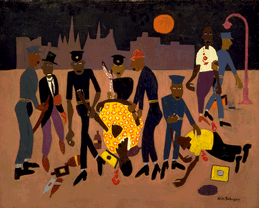
    Moon Over Harlem, William Henry Johnson (1901-1970) NEW YORK (AP, March 24, 1997) - Outside the Great Wok, a spindly man in bright yellow sweatpants looks both ways before pushing his hand down a fist-sized hole in the sidewalk. A few seconds later, he shuffles away.
    That the deal for crack cocaine happened at all is a sign that New York City's war on drugs hasn't shut down the narcotics trade. Instead, some dealers have moved to the suburbs or gone underground - in this case, to a basement extending below a crumbling Brooklyn sidewalk fronting a dingy Chinese restaurant.
    "Have (the dealers) quit and gotten 9-to-5 jobs? No," said Capt. Kevin Perham, a commander involved in the crackdown. "But we've made it very uncomfortable for them. ... They're going to pretty great lengths not to deal on the street."
    It's been nearly a year since police began an expensive crackdown on dealers in north Brooklyn, where the drug trade was blamed for fueling up to 40 percent of robberies, shootings and other violent crime. What followed was a year of undercover stings, surprise searches and stepped-up street patrols.
    The effort is part of Mayor Rudolph Giuliani's campaign against prostitution, panhandling, graffiti and other "quality of life" crimes. Critics say targeting drug peddlers without addressing problems that feed demand - addiction, poor schools, unemployment, broken families - will have no lasting impact.
    "My fear is that while dealing is less visible in some places, it's more visible in some new area," said Monsignor John Powis of St. Barbara's Roman Catholic Church. "It still appears that anyone who wants drugs can get them, and rather easily."
    Allan Clear, head of the drug addict advocacy group Harm Reduction Coalition, said the police strategy won't work: "Eradicating drugs is a utopian dream. It's not going to happen."
    Police say they have made progress, pointing to 1996 statistics from the targeted precincts - narcotics arrests up 16 percent; reports of serious crime down 22 percent; shootings down 23 percent; robberies down 14 percent.
    It isn't cheap. The drug battle in Brooklyn is expected to cost the city $30 million this year and next. There are similar plans for other parts of the city.
    In one Brooklyn neighborhood, where dealers eight years ago executed a mother for tipping police, a once-thriving heroin trade appears dead after police arrested 50 people in a raid last year.
    Steve Martin, 34, said the days are over when he had to say "excuse me" to dealers loitering on his stoop or worry about letting his five children out to play. He credits the police.
    "They've stopped all that crap," Martin said.
    There are indications that some of the drug suppliers have moved out of town, said Anthony Senneca of the city's U.S. Drug Enforcement Administration office. There have been large drug seizures in the suburbs, including 1,240 pounds of cocaine last year in Westchester County, north of New York City.
    But the hole in the Brooklyn sidewalk remains, a sign of dealers' determination. Police have filled it with cement and sealed off the basement, but dealers have broken in and poked new holes.
    Authorities admit they can't stop drug sales as long as there are buyers. But they argue that changing the way dealers do business is a worthy goal.
    "It's not victory," Senneca said. "But we're winning one battle."


    "School Suspends Students For Tasting Alka Seltzer"

    BREMERTON, Wash. (AP, March 21, 1997) - Fifteen middle school students were suspended for three weeks for tasting Alka Seltzer on campus in violation of their district's zero-tolerance drug policy.
    Even bringing the antacid to school is a violation of the policy, Assistant Superintendent Mariwyn Tinsley said Thursday.
    Austin Hicks, a sixth-grader at Mountain View Middle School, said he tasted the broken antacid tablets because a friend told him they were candy. "After lunch I got called into the office" and suspended, he said.
    His mother, Darla Hicks, said the district needs to keep things in perspective. "This is not cocaine, this is not LSD or marijuana or anything like that" she said.
    The students can opt for a three-day suspension and attend drug-awareness classes and counseling instead.


    Teen Smoking Up 30 Percent

    As Liggett agrees to new warnings, a study questions effectiveness
    Research finds many adolescents don't read labels.
    Nicotine is found to be the key obstacle to quitting.

    The Philadelphia Inquirer, March 21, 1997
    By Robert S. Boyd
    Inquirer Washington Bureau

    Girl smoking WASHINGTON - Will tougher cigarette warnings work?
    The Liggett Group's agreement to mark its packages with a warning that cigarettes are addictive comes after 30 years of increasingly somber cautions about the danger of tobacco.
    During that time, cigarette smoking has dropped by half among adult males and by one-third among adult women. But it is increasing sharply among teenagers, when the habit is usually picked up.
    In fact, teenage smoking increased by 30 percent from 1991 to 1995, according to a study published yesterday by the Stanford University School of Medicine.
    "Sizable proportions of adolescents are not seeing, reading and remembering cigarette warning labels," said the study, which surveyed 1,700 high school freshmen in San Jose. "Knowledge of warning labels was not associated with subsequent decreased smoking."
    The labels now say that smoking causes cancer, emphysema and other diseases, but do not mention addiction.
    Researchers say that three out of four people who start smoking become confirmed addicts, and that 90 percent of those who try to quit each year fail. [Contradicted by information at http://www.pdxnorml.org/Gazzaniga_excerpt.html - ed.]
    A major part of the reason is that nicotine is as addictive as cocaine and heroin, and even more habit-forming than alcohol, according to scientists who study addiction. [Contradicted in part by the information at http://www.pdxnorml.org/NYT_addictive_080294.html - ed.]
    Using modern electronic brain-scanners, researchers can see how chemicals in tobacco smoke permanently change the way brain cells, called neurons, communicate with one another. The changes make it extremely difficult - and often impossible - for people to quit.
    "Nicotine meets all the criteria of a highly addictive drug," said Jack Henningfield, an expert on drug and tobacco addiction at Penny Associates in Baltimore.
    Until a half-century ago, tobacco was considered neither harmful nor addictive. By the end of World War II, it was widely accepted that cigarettes were unhealthful, but not nearly as bad as hard drugs. Smokers called them "coffin nails" as they cheerfully puffed away.
    But during the 1970s, researchers began to unravel nicotine's addictive powers. In 1988, President Ronald Reagan's surgeon general, C. Everett Koop, issued a 618-page report declaring that "cigarettes are addicting in the same sense as are drugs such as heroin and cocaine."
    Koop ordered stiffer warning labels on cigarette packs. Smoking began dropping among adults, but kept rising among adolescents.
    Last year, President Clinton authorized the Food and Drug Administration to regulate nicotine as a dangerous substance. The FDA's proposed rules limiting access to minors are being challenged by a coalition of tobacco companies in federal court in North Carolina.
    The companies, with the exception of Liggett, deny that smoking is addictive, and point to the millions of Americans who have quit.
    In its settlement yesterday, Liggett, the maker of Chesterfield and other brands, agreed to add a prominent warning to each cigarette pack acknowledging that smoking is addictive and causes health problems, including lung cancer.
    A colorless, oily liquid composed of carbon, hydrogen and nitrogen, nicotine itself does not cause disease. Scientists say it is the other toxic substances in tobacco smoke - chiefly tar and carbon monoxide - that lead to cancer of the lungs, throat and other organs.
    But nicotine is indirectly responsible for the damage because it makes it so hard for smokers to quit.
    According to Henningfield, 5 milligrams of nicotine a day is enough to cause addiction. Each cigarette delivers about 1 milligram of nicotine into the bloodstream of a smoker.
    Within 20 seconds after it hits the bloodstream, nicotine reaches the brain and is distributed among the trillions of neurons that govern thinking, memory, perception and emotion.
    At that point, it stimulates the production of a chemical messenger, called dopamine, that helps pass signals from one neuron to another. This excess of dopamine produces the pleasurable sensations that accompany smoking, or the "high" that goes with cocaine.


    "Drug Agent Faces Charges"

    The San Jose Mercury News, March 27, 1997
    SAN FRANCISCO (AP) - A U.S. Drug Enforcement Administration supervisor was charged Wednesday with stealing more than $120,000 that was supposed to be used to buy evidence and pay informants.
    Clifford T. Shibata, supervisor of the DEA's Clandestine Laboratory Group in San Francisco, was indicted by a federal grand jury on 13 felony charges dating from August 1994 to November 1996.
    Shibata, 49, of San Mateo worked for the DEA for 24 years until his suspension late last year.
    The indictment accused him of embezzling money from a DEA account that was used for undercover purchases of drugs as evidence and for payments to confidential informants.
    Shibata routinely forged the signatures of DEA agents on forms that said they had used money from the account for authorized purposes, the grand jury said. It said he obtained sums of up to $6,450 at a time and converted the money to personal use, depositing some of it in his checking account.
    The charges include theft of government property, making false statements and mail fraud. The theft charge is punishable by up to 10 years in prison but generally carries about a two-year term under federal sentencing guidelines.
    The case is being prosecuted by the Justice Department's Public Integrity Section.
    Defense lawyer Stuart Hanlon said Shibata would be exonerated.
    "The DEA has incredibly sloppy record-keeping, has no real system to keep track of money used for informants in drug buys," Hanlon said. "They're trying to blame somebody. . . . Mr. Shibata never stole anything."


    "FBI Takes On New Job - Leading The Drug War"

    "Critics Allege The Drug Enforcement Administration's Turf Has Been Invaded"

    The Atlanta Journal and Constitution, March 21, 1997, p. 9A
    By Ken Foskett, Washington Bureau
    J. Edgar Hoover, the crusty patriarch of the FBI, would not allow his agents to touch drug cases, convinced that drugs would corrupt the FBI's integrity just as easily as they destroyed the addicts who abused them. But Hoover is long since dead, and the modern FBI is rapidly becoming the dominant player in the war on drugs, spending nearly a third of its $3 billion budget on narcotics enforcement.
    FBI agents eavesdrop on phone calls of drug traffickers, work with the Drug Enforcement Administration to break up drug syndicates exporting narcotics to the United States from Mexico and, more recently, have targeted street gangs that sell drugs.
    Over the past five budget years, federal funds appropriated to the FBI for drug enforcement have jumped 82 percent, more than any other agency with federal drug oversight, including the DEA.
    In Georgia, the FBI works many of the drug cases outside metro Atlanta and is starting to take part in cases inside the city as well, particularly in the arrest of drug-dealing street gangs.
    "Two or three years ago, you were not looking at federal prosecutions of street 'gangbangers,' " said Buddy Parker, head of the Justice Department's Organized Crime Drug Enforcement Task Force in Atlanta. "FBI . . . resources have been diverted to areas that used to be local drug enforcement." This year, the FBI is asking for $42 million in new anti-drug money, most of it to expand the bureau's enforcement program along the southwest border with Mexico, a joint FBI/DEA initiative; $10 million is earmarked for new wire-tapping technology.
    Some critics charge Congress' generosity with the FBI has come at the expense of the DEA, which they say is better suited to cracking drug crimes.
    "The French Connection was broken up not by the FBI but by the DEA," said Peter Bensinger, DEA's administrator from 1976 to 1981, referring to the heroin pipeline from France to the United States in the 1970s. The FBI's "method of investigation does not strike me as earth-shattering."
    But the FBI's supporters say that Congress' decision to pour millions into the FBI reflects the success of the bureau's "enterprise" approach to solving drug cases, cloned from tactics used against organized crime.
    "The purpose is to collect intelligence and evidence on the entire organization and take it out, including its operatives, its holdings, its properties, its bank accounts," said Buck Revell, an Atlanta native who served as the FBI's third-ranking administrator from 1979 to 1991. Revell contrasted the FBI's tactics to the "body count" methods at the DEA, whose agents target dealers and drug kingpins with sting operations.
    "The DEA is still largely a transactional agency," Revell said. "It takes credit for anything that touches it, therefore its statistics look spectacular but their impact sometimes is not very significant." But measuring the FBI's performance is also difficult.
    Federal drug prosecutions have risen less than 3 percent since 1992 despite the huge infusion of funds.
    The quantity of illegal drugs entering the country has declined, but dangerous drugs such as heroin and cocaine have become cheaper and more potent.
    Some in Congress believe the United States is losing the war on drugs, particularly in Mexico. The four major drug cartels in Mexico, which serves as the transshipment point for 70 percent of the cocaine and 50 percent of the heroine entering the U.S., operate freely.
    The FBI and the DEA scored a substantial hit against the cartels with the conviction last year of drug lord Juan Garcia-Abrego, formerly one of the FBI's 10 most wanted suspects. FBI, DEA and other law enforcement agents seized 5,600 kilos of cocaine, $17 million in cash and assets and arrested more than 150 people in the investigation.
    "We're pouring money down DEA and FBI like nobody's business," said Rep. Hal Rogers (R-Ky.), chairman of the House appropriations subcommittee with oversight of the FBI and DEA. "They are beefing up and building up and doing all they can, yet we are confronting insurmountable odds."
    Congress gave the FBI jurisdiction over drug cases in 1982, a move that Hoover had adamantly resisted before he died in 1972.
    "It had to do with his believing that drugs were a local problem, that drugs were a vice," said Revell.
    Hoover biographer Athan Theoharis said Hoover believed drugs would also corrupt the bureau's image.
    "There was this whole campaign to establish the professionalism of the bureau" under Hoover, Theoharis said. "Certain kinds of activities would compromise agents and detract from that image." After Hoover's death, FBI officials began lobbying Congress for drug jurisdiction, recognizing that drugs were the primary income of organized crime.
    The breakup of the so-called pizza connection in the mid-1980s, in which New York Mafia families were laundering heroin money to Italy, was the FBI's first major victory in the drug war.
    More recently, as law enforcement officials understand the link between the Latin American drug cartels that produce drugs and the street gangs they employ to sell them, the FBI has targeted more and more of its money at gangs.
    For the first time, the FBI estimates that a majority of its violent crime budget will be tied up in drug investigations.


    "Tainted Testimony Leads To Release Of Three Convicted Drug Dealers"

    NORFOLK, Va. (AP, March 26, 1997) - Three convicted drug dealers were released from prison because federal agents did not disclose that a prisoner who testified against them was allowed to have sex in a government office.
    When the issue of sexual favors was raised at trial, the judge told the jury that there was no sex-for-testimony deal with witness Gary Weathers.
    Defense attorneys discovered the arrangement after Weathers' wife gave birth to twins in 1991 and named him as the father. Weathers had been imprisoned since 1989.
    According to court papers, Weathers was permitted to have about a half-dozen private "lunches" with his wife or a girlfriend in the Drug Enforcement Administration office in Norfolk in May and June of 1990.
    Bruce E. Boone, convicted for his role in a Portsmouth gang that sold $20 million in heroin from 1984 to 1989, was freed Tuesday from a life sentence.
    Larry Torrence, an FBI official, said Boone was not retried because it would be hard to reconstruct the case nearly 10 years after the investigation.
    Samuel Collins Jr., serving a life sentence, and William Kenneth Banks, serving a 25-year sentence, were released Nov. 14. The sentences of four other members of the Portsmouth drug ring were shortened.
    U.S. Attorney Helen F. Fahey said she was "outraged by the fact that major drug dealers had to be released back into the community and had to have their sentences substantially reduced because of the misconduct of law-enforcement officials."
    The FBI and DEA agents involved are still on the job pending the outcome of a Justice Department investigation.


    "Marijuana May Win OK For Use In Religion"

    "A Big Isle Man Calls the Drug a Sacrament to His Church"

    The Honolulu Star-Bulletin, March 25, 1997
    by Rod Thompson, Big Island Correspondent
    Kealakekua, Hawaii - The religious right to smoke marijuana could be established in a trial starting today with jury selection.
    Dennis Shields, 49, a minister in the Religion of Jesus Church, was arrested at his Captain Cook home in 1994.
    Police found several ounces of marijuana and charged him with misdemeanor possession of a detrimental drug, punishable by up to a year in jail and a $2,000 fine. Shields does not deny the marijuana was his but says it is a sacrament in his church.
    He sought protection under the U.S. Religious Freedom Restoration Act of 1993.
    Congress passed the law to restore the religious right to use drugs after an Oregon court ruled Native Americans had no right to use peyote. Shields said the law sets up five steps a person must pass to be protected.
    The first two are that the religion must be legitimate and the individual must have a sincere belief in it. Shields said the prosecution has already agreed to those points in his case.
    Shields has been a long-time member of his church, which was founded on Kauai by James Kimmel nearly three decades ago.
    Deputy Prosecutor Melvin Fujino confirmed an agreement exists but declined to describe its details.
    The third point is that Shields must demonstrate that state marijuana laws put a burden on the exercise of his religion.
    Because that is the starting point, Shields and his attorney, Jack Schwrigert, will present their side of the case to the jury first. That is a reversal of the normal procedure in which the prosecution goes first.
    If Shields proves he is burdened, the prosecution must show the state has a compelling interest which requires it to burden him.
    Finally, if the prosecution shows a compelling interest, it must also prove that present marijuana laws are the least restrictive way to achieve that interest.
    The 9th U.S. Circuit Court of Appeals has ruled that a lower court was wrong when it failed to consider a Rastafarian's religion when convicting him for marijuana possession, Shields said. the appeals court ordered a retrial.
    In Shields' case, the court is considering his religion, but this appears to be the first time a court has considered the questions of burden and compelling interest.


    New York Restaurant Uses Hemp Oil And Seeds In Exotic Dishes

    "Restaurant uses hemp oil and seeds in exotic dishes"

    The Detroit News, March 25, 1997
    By Cathy Hainer, USA Today
    At the Galaxy restaurant in Manhattan, patrons are inhaling chef Deb Stanton's food. Some even may be tempted to smoke it.
    That's because Stanton is one of the few chefs cooking with hemp. Stanton cooks with hemp seeds and a flour made from milling them and with hemp oil. Galaxy's menu includes Granny Smith hemp-crusted apple pie, made with the flour; soba noodle salad made with hemp oil; and chocolate bananas Foster with hemp seed brittle.
    Hemp seeds and oil don't produce the "high" of their cousin, marijuana. Both come from the cannabis sativa plant, but marijuana derives from the plant's buds; hemp seeds are, well, the seeds. Hemp seeds and oil are perfectly legal, says Galaxy owner Denis Cicero. "The seeds are cold-pressed, and that process removes the tetrahydro-cannabinol, or THC, the psychoactive ingredient." Advocates say there are no risks with eating hemp-enhanced dishes.
    But doubts remain. Although hemp seeds are supposed to be sterilized, "people who eat these dishes could test positive in a drug test," says Rogene Waite of the Drug Enforcement Administration.
    No metro Detroit restaurants seem to have caught the trend, but creative cooks can concoct their own dishes - the People's Food Co-op and the Pure Productions hemp-clothing store, both in Ann Arbor, stock hemp oil, and the co-op also sells hemp cheese.


    "Los Angeles Sues Street Gang"

    Original Gangstas LOS ANGELES (AP, March 22, 1997) - The city is taking its war against a street gang to court.
    A lawsuit filed on Friday in Los Angeles Superior Court seeks an injunction barring members of the 18th Street Gang from congregating in a 17-square-block area near eastern Culver City.
    "The defendants have waged a gang war, including engaging in murders, drive-by shootings, brandishing and discharging firearms, drug use, drug sales (and) graffiti... against the residents who live in and use the area," the complaint said.
    On Friday, dozens of police officers fanned out in the area, regarded as the gang's home turf, "to serve gang members with the lawsuit," City Attorney James Hahn said in a statement Saturday.
    Similar injunctions against gangs in California cities have been issued by judges, including one filed last November in Compton.
    The gang abatement suit names 18 alleged members and includes their street aliases, such as "Clown" and "Lil Man."
    If a judge grants the injunction, they would be barred from sitting, standing, walking, driving or gathering together with other gang members.
    They also would be barred from selling or possessing drugs, acting as a lookout for the gang, harassing people or blocking the "free passage" of any person or vehicle.
    The city also is seeking an 8 p.m. curfew for minors and a 10 p.m. curfew for adults in the area, with exceptions for those returning from work or otherwise going straight home.


    "Prison Economics - The Cold War Comes Home To Roost"

    By Danny Mack
    [Danny Mack is currently an inmate in one of America's prisons. This article was originally published in the
    Loompanics Unlimited Spring 1997 supplement.]
    "When the tyrant has disposed of foreign enemies by conquest or treaty, and there is nothing to fear from them, then he is always stirring up some war or other in order that the people may require a leader." - Plato
    Prison The cold war, which began as a standoff with Joseph Stalin in 1945, ended in a 1993 period of "detente" which is Russian for "We're really tired, can we stop this?" While it lasted, life in United States was shaped by it.
    The fear of communism, fueled in large part by the alcohol-induced paranoia of Senator Joe McCarthy, was the impetus behind America's involvement in virtually every foreign civil war for the last 50 years, including Vietnam. The cold war cost us $20 trillion, and 118,000 lives. Once we were convinced that communism was the greatest of all evils, money and lives were no object.
    We are just now beginning to learn that the Soviet threat was, to put it mildly, greatly exaggerated. It was necessary for all Americans to fear Russia. Otherwise we never would have agreed to the vast spending by the Pentagon on "defense." Corporations such as Boeing and McDonnell Douglas were literally created by the American public's fear. The fact that Russia was bankrupt and no longer the superpower or "evil empire," as we had always been told, didn't stop the Reagan/Bush administration from escalating the military buildup. Russia's impotence, though it was known to our State Department, was kept from the American people during the 80's for two reasons. First, it gave our fearless leaders time for one last-hurrah spending binge. More importantly though, before the Iron Curtain was lifted to reveal the great Russian bear as a near-Third World country, it gave them time to create an equally frightening new enemy within our own borders.
    Today's "criminal" is our new bogeyman, and the political rhetoric is every bit as paranoid as that of the McCarthy era. Cold War defense contracts have been replaced by Crime War prison contracts in our race to lock people away from society. America needs an enemy, and with the worldwide fall of communism we have turned our anger and aggression inward, declaring war on our own people. The prison building programs, begun in the 80's, continue at a rate unprecedented in world history. With 1.6 million people behind bars and over five million under the control of the justice machine (either on parole, probation, or on bail), America is by far the world leader in locking up its own citizens.
    The timing couldn't have been better for this shift in institutionalized hatred. In a high-tech world there is no place for low tech-people. The displaced and disaffected victims of the technology boom are at the bottom of the economic food chain, and as Richard Nixon discovered during his 1968 campaign, poor people can be a formidable political force if they are not kept under control. Reagan's trickle-down economy turned out to be a flood-up economy, and the gap between rich and poor became greater than ever. Ten percent of the U.S. population owns 90% of the riches. The government is charged with protecting this very rich minority from the rest of us, and the threat of imprisonment is a very effective tool when it comes to keeping the huddled masses in line. The national debt is blamed on welfare mothers, violent crime on the very young, and the drug problem on poor blacks. The solution, according to the ruling class, is to lock them up and throw away the key. Never mind that it would cost less to house, feed, clothe, and send them to college. That would never satisfy our national hunger for vengeance. The least able to defend themselves are always made into scapegoats.

    Growth Industry

    As programs and entitlements are cut, Oregon, like many other states, has seen an explosion in the number of homeless teens on its cities' streets in recent years. The state legislature's response to this very visible sign of poverty was to pass Measure 11, which went into effect April 1, 1995. This Draconian measure allows 15-yer-olds to be prosecuted as adults, and 16-year-olds to actually be placed in adult prisons. It also mandates very long sentences, even for first- timers, with no possibility for parole. The list of crimes that can be prosecuted under Measure 11 makes it appear to target only the most serious crimes against persons or property, but days after it went into effect a Portland youth was charged with kidnapping, for pushing an acquaintance out the front door of a friend's home and punching him in the nose. The sexual-abuse section of the statute says that a 15-year- old who touches the buttocks of a 12-year-old, even with consent, must be sentenced to 8 1/2 years in prison, 7 1/2 years which could be served in an adult prison. Just imagine the 23-year-olds we'll get out of THAT deal! It's no coincidence that Measure 11 went into effect on April Fool's Day. The voters don't have a clue as to the nature of the monster they are building.
    As a result of Measure 11, Oregon now needs ten new prisons. California is also in the middle of a prison-building spree after the passage of their "Three Strikes You're Out" law, under which the theft of a 50-cent slice of pizza can get you thirty years in that state's brutal corrections system. The object of this tough-on-crime philosophy is obviously not to reduce crime (in fact, it turns misguided youths and petty crooks into full blown sociopaths), but to build prisons.
    The prison business is the fastest-growing industry in the country, and the reasons are purely economic ones. In a world economy where most of the manufacturing is done in Third World countries, millions of Americans have been left with no meaningful work. The "make-work" of the prison industry, although it is degrading and produces nothing of value, is often the only alternative for the downsized.
    More people are employed in the prison industries than in any Fortune 500 company except General Motors. A large majority of prison guards are young men and women fresh out of the military. Ninety-five percent of these are recruited by the Federal Bureau of Prisons before they are discharged. The skills learned in the military services are considered desirable by the B.O.P, but few of these recruits have skills that would be marketable in the civilian workplace. The regimented by-the- book life of the prison system is a perfect environment for those whose first life experience after high school was military service.
    Small, depressed rural communities are targeted for prison construction because the money that prisons bring with them outweighs the usual fears of having one in your backyard. Escapes are so rare as to be almost nonexistent, and the theory that undesirable relatives of the prisoners will move into the area has been proven less of a problem than anticipated. Many people are put to work immediately upon the approval of a new prison site. Draftsmen, architects, engineers, construction workers, and material suppliers all benefit from the prison boom. After construction is completed, literally thousands of people will become dependent on the prison for their livelihoods. The B.O.P. has a policy of hiring 60% of its total staff from the local communities. It is common for husbands and wives to work together at their local penal institution.
    Not only do local businesses such as laundries and food suppliers share in this new-found wealth, but a new breed of entrepreneur has also emerged, offering mail-order gifts, quasi-legal services for prisoners, and transportation/lodging for visitors. Another advantage to a small community is the fact that prisoners can be counted as citizens in a local census. With the population increasing by one or two thousand souls overnight, government allocations for sewer, water treatment, and road maintenance also increase. This is a big selling point for small towns where the population may actually double with the building of a single prison.
    The alarming thing about all of this economic well being, is that it induces a political shift to the right in the hearts and minds of those affected. What prison guard or support staff in his or her right mind would ever oppose a bill that would lock up more people for greater lengths of time? How could a business owner who depended on this prison-generated income vote in favor of programs designed to decrease recidivism? It's a simple matter of job security.

    Prisons for Profit

    The private sector has not been able to ignore the lure of big bucks in the prison business. Federal officials are now comfortable with allowing private companies to run federal prisons, because the industry has gained experience running state and local jails. Wackenhut Corrections and Corrections Corporation of America, the two industry leaders, make a profit by housing prisoners for the federal government. Both trade on the New York Stock Exchange.
    Corrections Corporation, a 13-year-old company based in Nashville, Tennessee, employs many former government officials, including, as director of strategic planning, Michael Quinlan, who directed the B.O.P. during the Bush administration. Wackenhut, of Coral Gables, Florida, has as its director, Norman A. Carlson, who preceded Mr. Quinlan as director of the B.O.P. Benjamin R. Civiletti, a former Attorney General, also works for Wackenhut.
    In 1993 the Donald A. Wyatt Detention Facility was opened in Central Falls, Rhode Island. Wyatt is owned and operated by Cornell Corrections, a private company financed by investors. The facility had 300 beds and a contract with the federal government for $85 a day per prisoner, but no inmates. "Build it and they will come" seemed to be the philosophy at Cornell, and when they didn't come it was quite an embarrassment. Wyatt would need a full house to survive. The prison's financial backers, realizing that their investment was in jeopardy, mounted a vigorous lobbying campaign to divert prisoners from other states. Facing bankruptcy and angry bondholders, Cornell Corrections turned to a lawyer who specialized in brokering prisoners for private prisons. Attorney Richard Crane was paid an undisclosed sum when 232 prisoners were moved from North Carolina to Rhode Island soon afterward.
    When Wall Street analysts and brokers, lawyers, corporate CEO's, and rich investors stand to profit from locking people up, you can bet that they will be throwing large amounts of money at politicians who favor the imprisonment of an ever growing segment of the population. In the short term, Cornell was lucky that North Carolina needed to relieve some overcrowding. Long-term, the prospects are frightening. At this point, can we be far from the days of the debtor's prison? The strongest power the government has, short of the death penalty, is that of incarceration. That power should not be handed to those motivated by profit.

    Slavery '96

    Contrary to what we learned in grade school, the 13th Amendment to the Constitution did not abolish slavery in 1865. The Amendment reads, "Neither slavery nor involuntary servitude except as punishment for a crime whereof the party shall have been duly convicted, shall exist within the United States, or any place subject to their jurisdiction." The purpose of this Amendment was not to abolish slavery, but to limit it to those who had been convicted of crimes. The sad fact is that great numbers of newly freed blacks were then "convicted" and forced to work without pay in state prisons. This simply transferred the ownership of slaves from private parties to the state. Today, with the advent of private, for-profit prisons and joint-venture prison factories, this ownership is shifting back to the private sector. Slavery has come full circle.
    UNICOR, the prison manufacturing industry of the B.O.P., and by far the largest slaveholder in the U.S., makes a wide range of products for sale to other government agencies and contractors. UNICOR is the "preferred" supplier for these government customers. The word "preferred" in this case is intentionally misleading, and actually means mandatory. If the U.S. Navy needs 500 wooden chairs, and doesn't want to buy them from UNICOR because of over-pricing, poor quality, and slow delivery, it is required by law to ask UNICOR for an exemption. These exemptions are never granted, and this is how "preferred" becomes "mandatory." With this kind of lock on such a huge section of the market, the concepts of competition and free trade go out the window.
    UNICOR operates 90 prison factories and is rapidly expanding. The products range from office and dormitory furniture to electronics. Individual states have modeled their prison factories after the federal example, with one dangerous difference: They market their products to the private sector. San Quentin inmates enter computer data for Bank of America, Chevron, and Macy's. Prisoners in New Mexico take hotel reservations by phone. Hawaiian convicts package golf balls for Spaulding, and at Folsom they manufacture stainless steel vats for beer brewers. The list goes on and on. Businesses all over the country are jumping at the chance to hire prisoners, and why not? There is no unemployment insurance to pay, no health benefits, vacation, sick leave, or payroll taxes. It is estimated that total prison sales will reach $8.9 billion by the year 1999.
    And how about prison labor for strike breaking? It's certainly nothing new. In 1891 in Briceville, Tennessee, mine owners attempted to break the miner's union by using prison laborers. In what is now known as the Coal Creek Rebellion, union workers took over the mine and freed all of the prisoners, thus temporarily ending prison labor in Tennessee. More recently, young inmates at the Ventura Youth Facility in California made flight reservations by telephone for TWA while unionized flight attendants were on strike. The company then transferred ticket agents to flight attendant jobs.
    What will happen to all of the free world workers who are displaced by the slave labor of the 90's is the most depressing thing of all. After their unemployment insurance runs out, and they discover that retraining is of no use when there are no jobs to be had, they will become members of the group most likely to end up in prison: the poor. At a January 1996 town-hall meeting in New Hampshire where Senator Phil Gramm was campaigning for the GOP primary, he pitched a proposal that would require all prisoners to work six days a week for sub-minimum wages manufacturing consumer goods in private no-frills prison "enterprise-zones." A woman in the crowd was heard to shout, "In order to get a job, an American is going to have to commit a crime!"

    The Cycle

    Despite a declining crime rate, a lot of money is being made from increasing incarceration. Unfortunately, it doesn't appear that this cycle will be broken anytime soon. As long as big business owns our political system and profits from prison building, the momentum of the Crime War will continue. One encouraging fact is that, at some point, there must be a level of diminishing returns. When every family in America has a member behind bars, a political change will be enevitable. Knowledge is the key to a free and equitable society. We must ask tough questions and demand answers. Remember, the Cold War lasted 50 years. Let us hope the Crime War ends sooner.


    Drug-War Peace Breaks Out In Vancouver, BC Pot Speakeasies

    "Pot Bar Arthrology Turns a New Leaf on the City's Social Scene
    Soft drug bar takes the city one step closer to Amsterdam style tolerance"

    The Vancouver Echo, March 26, 1997
    By Mike Bell, staff writer
    Vancouver The work week is winding down and Arthrology is beginning to wind up. It's Friday afternoon and one of Vancouver's newest cutting edge social clubs is getting busy.
    A buzz sounds every few minutes from the front door along a main street in the northeast corner of the city. This time Norm checks the surveillance camera before letting in a 50ish man in shorts and a cycling shirt. He looks around at the renovations and paint that in three months has transformed a filthy three-room warehouse into a comfortable collective with sofas and chairs scattered in small clutches, a tiny stereo system, video games, even a pet fish.
    "Hey it looks great," he smiles to Norm and the men share a pat on the back before adjourning through the smoky haze scented with marijuana to a back room. On the other side of the curtains Norm maintains a kind of soft drug bar, selling all kinds of pot, hash and miscellaneous substances to customers of Arthrology, from the Greek "arthro" for joints, and "ology" the study of.
    "Welcome to Arthrology," Norm tells all his new customers. An intimidating figure at 6 foot 4, 300 pounds, Norm tends to hold people's attention through his entire introductory spiel and so far everyone has played by the rules.
    "We're a cannabis club," he continues. "We sell only cannabis products. No alcohol please, do your drinking after you leave, not before you come. This is a powder-free zone, nothing up your nose but your finger - anything other than your finger up your nose and your ass goes out the door. We reserve the right to install a dress code and control the altitude, aptitude and attitude of all guests. Video games are free," he points to three standing against the wall, " and the tea bar is by donation. The television has all the specialty channels - watch whatever you want - and there's games in the front room. Enjoy."
    There are a few other common sense rules. No stolen property on the premises, no selling outside marijuana and no customers under 18, consciously in accordance with Canada's age of majority. Behave like you would in a pub, but replace your beer with weed.
    Selling marijuana is the commercial end of the operation, the rest of the space is open. Some people sit and sip tea and play cards. Others stop by to smoke a bowl of high - grade marijuana in one of several waterpipes around the rooms and settle into a good book. Few stay less than 15 minutes. Norm wants to deter the constant in-and-out traffic that attracts attention and wants to keep new Arthrologists (club regulars) " to people you smoke with at your kitchen table." He's hoping some grassroots level groups will use the Arthrology space as a meeting place.
    "It's totally open," he said invitingly. " People can do whatever they want here and I hope they'll use it as a place to organize, to get their groups together."
    As the owner of one of several underground Amsterdam - style smoking bars that have stayed open as long as two years in Vancouver, Norm is hopeful a low key approach is the one that keeps Arthrology open. Vancouver police might have tolerated The Harm Reduction Club and its efforts to sell pot from a basement suite off Commercial Drive were it not for vocal spokesperson David Malmo - Levine and Marc Emery ( the Hemp BC owner arrested last year for selling marijuana seeds to undercover cops), police appear to have seen the writing on the wall and seem to be offering a break of sorts to those who operate discretely.
    As far back as the Liberal government's LeDain Commission in 1973 when Jean Chretien and other commission members advocated softening up Canada's pot laws, politicians have been saying the current prohibition of growing, owning , smoking or selling marijuana is wrong. Four years ago then - provincial chief coroner Vince Cain recommended the legalization of soft drugs, now 73 year old senator Duncan Jessiman - who doesn't smoke it - wants pot legalized.
    No substantive steps toward legalization have been taken since the Liberal party battled back to parliament, but there is a palpable sense that police know pot, like prostitution, isn't going away and will provide a similar level of tolerance for those who do their business away from bright lights and any attention.
    "I know they've checked me out and I know they know I'm here," said Norm, " I just hope they realize that what's going on in places like this is not criminal. I've done a lot of shit, but for 15 years this has been my dream, now it's here. What this is is kind people selling kind herb to kind people and to say what we're doing is criminal is absolutely wrong."


    McCaffrey - Drug Lords Kill 'Hundreds' Of Mexican Cops, Spend $6 Billion To Bribe Others

    MEXICO CITY (Reuter, March 25, 1997) - Drug traffickers have murdered "hundreds" of honest Mexican law-enforcement officials in the past year, U.S. drug policy coordinator Barry McCaffrey said on Tuesday.
    "Hundreds of honest police officers and prosecutors and judges have been murdered in the last year struggling to protect Mexican democracy," McCaffrey told the Mexican television network Televisa from Miami.
    McCaffrey is the White House representative who coordinates the U.S. anti-drug effort.
    An excerpt from the interview was broadcast on Tuesday night on the 24 Hours news programme.
    International drug traffickers who move billions of dollars worth of cocaine, marijuana and heroin through Mexico each year are known to be violent, but officials have been reluctant to quantify the number killed while attempting to stem the tide.
    McCaffrey also said drug traffickers spend $6 billion of their profits each year to bribe Mexican officials and grease the path for their illicit products.
    "Violence and corruption are the two tools of international crime, and in this case it's with $6 billion of corruption money that comes from the United States," McCaffrey said. "So it's a terrible challenge to Mexico and the United States to work together for the years to come."
    U.S.-Mexican relations in the war on drugs became strained recently during the U.S. "certification" process of determining whether Mexico is an aid-worthy ally in combatting the narcotics trade.
    The Clinton administration, including McCaffrey, stood by Mexican President Ernesto Zedillo, calling him an honest warrior even if many below him are corrupt.
    The U.S. House and Representatives and Senate have taken less friendly views, voting to partially overturn Clinton's certification of Mexico.
    Mexico has rejected the certification process as a unilateral attempt to trample over Mexico's internal affairs, while Mexican commentators have criticised the United States for providing the world's most lucrative drug market.


    Clinton Gets Mexican Certification

    "Senate Resolution Blasts Mexico's Anti-Drug Efforts
    Congress: As expected, measure stops short of urging decertification, signaling victory for President Clinton."

    Los Angeles Times, March 21, 1997
    By Stanley Meisler, Times Staff Writer
    Ole' (bullfight) WASHINGTON - The Senate on Thursday berated Mexico for "ineffective and insufficient progress" in the war on drugs but as expected held back from challenging President Clinton's certification of Mexico as a cooperative ally in the worldwide narcotics battle.
    The vote on the resolution - a compromise hammered out by key senators and the administration's foreign policy team - was 94 to 5.
    Its overwhelming passage could be counted as a political victory for Clinton, who did not want Congress to rile U.S.-Mexican relations by overturning his certification.
    As a practical matter, the vote ended any attempt by Congress this year to decertify Mexico, an action that would have caused economic sanctions to take effect. Both houses begin their Easter recess today and will resume their sessions after the deadline for reversing the president on certification.
    Clinton issued his ruling at the end of February, and Congress has no more than 30 days to change it.
    But Sen. Dianne Feinstein (D-Calif.) warned the administration that there could be "a major battle next year" if the president ignores the resolution and Mexican officials do not provide evidence of major reform of the corruption within its anti-narcotics agencies.
    The House passed a much tougher resolution last week but now must decide whether to accept the Senate version and send it to Clinton or seek a compromise. The House resolution, which Clinton pledged to veto, would have given Mexico three months to improve its drug-fighting efforts or then face decertification.
    Under the Senate resolution, the president would be required to issue a report by September on the progress that both the United States and Mexico have made on a series of key steps in their joint war on drugs.
    These steps include dismantling drug trafficking cartels, strengthening the relationship between the law enforcement agencies of the two countries, increasing joint patrols on the border, extraditing criminals from one country to the other, implementing money laundering laws, eradicating illegal drug crops in both countries and helping Mexico "identify, remove and prosecute corrupt officials at all levels of government."
    Barry R. McCaffrey, the U.S. narcotics czar who took part in the talks that produced the Senate resolution, hailed it as "a tremendous outcome of many serious discussions."
    He said that, while its passage tells "both nations we expect concrete results, it did put the issue of certification behind us."
    McCaffrey said that he discussed the resolution with top Mexican officials during the day and told them it is "a good outcome that . . . respects the sovereignty of Mexico."
    Mexican Foreign Relations Secretary Jose Angel Gurria Trevino called the Senate decision a vote for cooperation and a "triumph of reason."
    Saying his country still opposes the U.S. practice of certifying those countries it considers allies in the drug war, Gurria said Mexico would accept the Senate's compromise. He said both nations need to get on with tackling the real enemy - drug traffickers.
    Senate Majority Leader Trent Lott (R-Miss.) assured senators that they would not be helpless if they did not approve of the president's report in September. "If we don't get action," he said, "the Senate has a powerful weapon. It's called the power of the purse."
    The administration's anxiety about U.S.-Mexican relations was reflected in the major players that it sent to Capitol Hill to negotiate the Senate resolution. The negotiations included National Security Advisor Samuel R. "Sandy" Berger, Treasury Secretary Robert E. Rubin and McCaffrey. At the last minute, Secretary of State Madeleine Albright discussed the issue with Lott.
    "I was shocked by all the people who got involved," Lott said.
    The Senate negotiating team was led by Sens. Feinstein, Paul Coverdell (R-Ga.) and Kay Bailey Hutchison (R-Texas). In fact, according to Sen. Richard G. Lugar (R-Ind.), the initiative for a compromise came from the senators.
    The president - despite having called senators to the White House to meet with key members of the Cabinet last week - realized only belatedly that he was facing "a runaway train" toward decertification, Lugar told reporters at lunch.
    Hutchison and Feinstein "saved the bacon on this when the White House was headed into the drink," Lugar said.

    Times Washington Bureau Chief Doyle McManus contributed to this story.


    Mexico's Web Of Corruption

    "Crime billions trap country in web of corruption"

    The Toronto Star, March 22, 1997
    By Linda Diebel - Toronto Star Latin American Bureau
    MEXICO CITY - Even a decade ago, drugs in Mexico meant hippies smoking pot on a beach and a few loosely organized crime families shipping marijuana and heroin north across the Rio Grande.
    They shipped cocaine, too, but the Colombians controlled the markets. The Mexicans were just the little guys. They took straight cash for helping the Colombians get their product through Mexico and over the border.
    Mexico's phantom war on drugs

    [photo caption:]
    A police agent carries off marijuana plants from a field in Sinaloa, part of Mexico's huge and growing traffic in illicit drugs. Now, however, the drug mafia is so big in Mexico there are genuine fears the government is losing control of the country.

    Drugs are a $37-billion-a-year business employing over 350,000 people. The drug industry has tentacles in every corner of Mexico and in every part of government and industry. It poses an increasing threat to Canada and the United States.
    Mexico's new top drug fighter vows to bust the gangs
    It's ugly. It involves executions, torture, kidnappings, extortion, disappearances and such widespread corruption that a Star investigation shows there is virtually no difference between narco-traffickers and federal agents. They're all involved in drugs, with police officers acting as executioners, facilitators and private armies for the cartels.
    President Ernesto Zedillo has called the drug mafia "the biggest threat to national security" that Mexico faces in the late 20th century.
    "They kill people," Zedillo said recently. "It's not just in Tijuana. They kill people in Mexico (City), they kill people in Guadalajara, they kill people in Sinaloa and they kill people in Tijuana."
    The attorney-general was fired four months ago amid corruption charges. Top generals have been jailed for working for the drug lords. And, every few months, another widespread purge is announced, with mass firings of corrupt federal agents.
    Apparently to no avail.
    "Zedillo has a time bomb on his hands," says Tijuana human rights leader Jose Luis Perez. "We see the drug organizations with huge economic power. That could very soon turn into political power.
    "This is the last war for Zedillo. If he can't change the rules of the game, civilian authority will be gone."
    Marijuana, of course, is a huge problem, So is the growing export of Mexican methamphetamines - speed - and heroin.
    But the big money is cocaine. An estimated 70 per cent of the cocaine imported into the U.S. comes from Mexico. In Canada, too, RCMP drug-fighting sources told The Star, cocaine is the largest drug problem, and growing quickly.
    In the 1990s, the Mexicans took over from the Colombians, who found it increasingly difficult to ship north through Florida. As the Medellin and Cali cartels weakened, the Mexicans grew more sophisticated. They demanded payment in cocaine from the Colombians for using Mexico as a transshipment point, and soon set up their own distribution networks in Canada and the U.S.
    "The Colombians are quite happy sitting back and leaving a lot more of it to the Mexicans," a U.S. Drug Enforcement Administration (DEA) agent told The Star.
    These Mexican cartels are so rich, so powerful, they're able to pay breathtaking amounts in protection money. The DEA estimates that bribes could account for as much as 60 per cent of the total take of the drug business. The country is awash in dirty money.
    A month-long Star investigation into Mexico's drug mafia in five states and in the U.S., including interviews with sources in hiding and access to secret federal documents, shows the extent to which Mexican officials, police agents and military officers are being corrupted and used by the drug bosses.
    "This is, at heart, a government at the service of organized crime," said a senior law-enforcement lawyer.
    "It's a circus. It's grotesque. What more can I tell you?"
    The Star uncovered cases of payoffs, coverup, murder and kidnapping related to drugs. For example:
    A former top-ranking national police agent, hailed for his fight against drug traffickers, was actually receiving $7 million a month in protection money from the cartels. This officer was very near the top of the heap for a long time, handling some of Mexico's biggest cases.
    He spoke to The Star from hiding; the interview came after months of negotiations. Perhaps he agreed because he was scared, and wanted to tell his story. His quicksand world had shifted, and he thought they - narcos and police agents alike - wanted him dead. He was trying to get out. He said, "I have water up to my neck."
    According to sources, he's now in hiding in the United States - probably protected by the DEA.
    As he became increasingly more important as a federal drug agent, he worked for a series of narco-tra