-------------------------------------------------------------------

NORML Weekly Press Release (Marijuana induces minimum driving impairment
compared to alcohol, Toronto study says; Gallup poll shows Americans support
medical marijuana by three to one margin; California Democrats adopt
resolution supporting hemp; Senate okays bill forcing Michigan cities to
impose criminal penalties for marijuana offenders; Crime committee kills
Minnesota hemp bill)

From: NORMLFNDTN@aol.com
Date: Thu, 1 Apr 1999 17:08:24 EST
Subject: NORML WPR 4/1/99 (II)

NORML Weekly Press Release
1001 Connecticut Ave., NW
Ste. 710
Washington, DC 20036
202-483-8751 (p)
202-483-0057 (f)
www.norml.org
foundation@norml.org

April 1, 1999

***

Marijuana Induces Minimum Driving Impairment Compared to Alcohol, Toronto
Study Says

April 1, 1999, Toronto, Ontario: Drivers under the influence of
marijuana pose far fewer risks on roadways than do drivers intoxicated by
alcohol, a new University of Toronto study suggests. The study
corroborates earlier research demonstrating that marijuana is not a
significant causal factor in traffic accidents.

"The failure of the Toronto University researchers to observe a
significant effect of marijuana on driving culpability is consistent with
findings from earlier studies," NORML Foundation Executive Director Allen
St. Pierre said. He noted that a May 1998 study by the University of
Adelaide (South Australia) Department of Clinical and Experimental
Pharmacology determined, "There was no evidence of any
increase in the likelihood of being culpable for [automobile] crash[es]
amongst those injured drivers in whom cannabinoids were detected. ...
[Their] culpability rates were no higher than those for the drug free
group."

Toronto researchers analyzed new data as well as several controlled
international studies and concluded that marijuana-impaired drivers
compensate by driving more slowly and cautiously.

"The more cautious behavior of subjects who received marijuana [in
studies] decreased the drug's impact on performance," said Alison Smiley
of the University's Mechanical and Industrial Engineering Department.
"Their behavior is more appropriate to their impairment, whereas subjects
who received alcohol tend to drive in a more risky manner."

The new study appears in the March issue of Health Effects of
Cannabis, a publication of Toronto's Center for Addiction and Mental
Health.

Previous marijuana and driving studies performed in the U.S. by the
National Highway Traffic Safety Administration also found "no indication
that marijuana by itself was a cause of fatal accidents."

For more information, please contact either Allen St. Pierre or Paul
Armentano of The NORML Foundation @ (202) 483-8751. California NORML
Coordinator Dale Gieringer is also available for comment @ (415) 563-5858.

***

Gallup Poll Shows Americans Support Medical Marijuana By 3 To 1 Margin

April 1, 1999, Washington, D.C.: Seventy-three percent of Americans
support amending federal law to allow for the legal use of marijuana as a
medicine, a Gallup Poll reported Friday.

"Medical marijuana is an issue where the voters are far ahead of the
politicians," NORML Executive Director R. Keith Stroup, Esq. said.
"Legislators must realize that legalizing marijuana as medicine is
politically safe and supported by mainstream Americans across all
political boundaries."

The Gallup Poll News Service stated that, "By a three-to-one margin
Americans would support making marijuana available to doctors, so it
could be prescribed to reduce pain and suffering."

These results mimic earlier surveys conducted by ABC News, The Luntz
Research Company, CBS News, and Lake Research that indicated a majority
of Americans from both parties support legalizing medical marijuana.

For more information, please contact Allen St. Pierre of The NORML
Foundation @ (202) 483-8751. To read the results of previous medical
marijuana polls, please visit the NORML website at:
http://www.norml.org/medical/polls.html.

***

California Democrats Adopt Resolution Supporting Hemp

April 1, 1999, Sacramento, CA: The California Democratic Party
adopted a resolution supporting hemp cultivation at their state
convention last weekend.

"This is a first step toward [the introduction of] hemp legislation
in California," said Sam Clauder III of Californians for Industrial
Renewal (CAIR), which put forward the resolution. Clauder said he hopes
to see Democrats introduce legislation this month supporting hemp.

Delegates resolved that, "The California Democratic Party endorses
the legalization of the domestic production of industrial hemp, and
strongly recommends to the state legislature that laws be adopted to
allow industrial hemp to be cultivated and harvested under the control
and regulation of the California State Department of Food and
Agriculture."

For more information, please contact either Allen St. Pierre of The
NORML Foundation @ (202) 483-8751 or Sam Clauder of CAIR @ (714) 543-6400.

***

Senate Okays Bill Forcing Michigan Cities To Impose Criminal Penalties
For Marijuana Offenders

April 1, 1999, Lansing, MI: The state Senate overwhelmingly approved
legislation last week that would impose criminal penalties for minor
marijuana offenders in the cities of Ann Arbor and East Lansing.

"Senate Bill 380 would needlessly subject thousands of otherwise law
abiding citizens in Ann Arbor and East Lansing who smoke marijuana to
criminal arrest and incarceration," said NORML Executive Director R.
Keith Stroup, Esq., who denounced the measure. "Many of these citizens
are college age students, just starting careers, who could find their
futures jeopardized by the long-term ramifications of an arrest and
criminal record."

Local ordinances in Ann Arbor and East Lansing punish minor marijuana
offenders with a $25 fine, a penalty that deviates from the state law
which calls for a $100 fine and up to 90 days in jail. Senate Bill 380,
introduced by Sen. Beverly Hammerstrom (R-Temperance), would prohibit
municipalities from adopting local drug ordinances with penalties softer
than the state law.

The Senate approved the measure by a 36 to 1 vote last Thursday. It
now awaits action by the House of Representatives.

For more information, please contact either Keith Stroup or Paul
Armentano of NORML @ (202) 483-5500. To read more about S.B. 380 or
additional pending state marijuana legislation, please visit the NORML
website at: http://www.norml.org/laws/stateleg1999.htm.

***

Crime Committee Kills Minnesota Hemp Bill

April 1, 1999, St. Paul, MN: The Republican controlled House Crime
Prevention Committee voted down a Senate bill that sought to establish a
regulated hemp industry in Minnesota. The defeat angered proponents, who
hoped Minnesota would become the first state to legalize hemp production,
and disappointed Gov. Jesse Venture who backed the legislation.

"This was an agricultural bill that had no business being placed in a
crime committee," said NORML Executive Director R. Keith Stroup, Esq.
The Senate had previously approved the legislation by a vote of 54 to 4.

Senate File 122 classified hemp "as an agriculture crop subject to
regulation and registration by the commission of agriculture." The
Legislature passed a similar version of the bill last year, but then-Gov.
Arne Carlson (R) vetoed it. That proposal was approved by the
Agriculture Committees in both Houses, and was never assigned to a crime
committee.

Several states this year have passed hemp reform proposals, including
Illinois, Montana, North Dakota, and Virginia, but none of these measures
license farmers to grow the crop.

For more information, please contact either Keith Stroup or Paul
Armentano of NORML @ (202) 483-5500. To read about additional pending
state marijuana legislation, please visit the NORML website at:
http://www.norml.org/laws/stateleg1999.htm.

				- END -
-------------------------------------------------------------------

School informant project runs into objections (The Oregonian says the
Brooklyn Action Corps, a neighborhood association in Southeast Portland,
wants to put a stop to the Campus Crime Stoppers, a citywide school program
that offers money to students to turn in their peers for criminal activity
such as underage drinking and drug possession, even if it happens after
school. "It scares a lot of people," said John Mathiesen, a member of the
association. At a recent meeting attended by parents, teachers and others in
the neighborhood, nobody was in favor of the program. Mathiesen pointed to a
recent situation involving his son, an eighth-grader at Sellwood Middle
School. He said his son and a classmate were falsely accused by another
student of marijuana possession.)

Newshawk: Phil Smith (pdxnorml@pdxnorml.org)
Pubdate: Thu, Apr 01 1999
Source: Oregonian, The (OR)
Copyright: 1999 The Oregonian
Contact: letters@news.oregonian.com
Address: 1320 SW Broadway, Portland, OR 97201
Fax: 503-294-4193
Website: http://www.oregonlive.com/
Forum: http://forums.oregonlive.com/
Author: Michael A.W. Ottey of The Oregonian staff

School informant project runs into objections

* A Southeast Portland neighborhood association wants to keep the Campus
Crime Stoppers out of the city's schools

Members of a Portland neighborhood group are objecting to a citywide program
in the schools that encourages students to turn in their peers in exchange
for money.

The Brooklyn Action Corps, a neighborhood association in Southeast Portland,
is checking into Campus Crime Stoppers, recently introduced to Portland
schools, to determine whether to ask the school board to keep the program
out of schools.

"It scares a lot of people," said John Mathiesen, a member of the
association. At a recent meeting attended by parents, teachers and others in
the neighborhood, nobody was in favor of the program, Mathiesen said.

The program, already in schools around the nation, pays students as much as
$1,000 for anonymous tips to police about crime in and around city schools.

Mathiesen said he will report back to the association at its next meeting
April 14.

"We'll still try to ask the school board to rescind the policy, provided the
neighborhood association agrees with that," Mathiesen said.

Off-campus activities

The program also encourages youths to report criminal activity by their
peers, such as underage drinking and drug possession, even if it happened
after school.

A goal to get the program in all of the city's middle and high schools is
close to completion, according to Sgt. Larry Linn, who oversees the program
for the Portland school police.

The program received the blessing of Mayor Vera Katz and several school
superintendents, including Ben Canada, when it was unveiled in January.

It is paid for by private donations.

The program, which is also in the Parkrose and David Douglas school
districts, gives out one telephone number -- 916-3222 -- for students to use
to report crime anonymously.

Mathiesen pointed to a recent situation involving his son, an eighth-grader
at Sellwood Middle School. He said his son and a classmate were falsely
accused by another student of marijuana possession.

"As soon as my son knew someone had snitched on him he knew immediately who
did it," Mathiesen said.

Mathiesen said he is against youths being paid to provide information to
police, particularly when the tip involves drugs and guns. At the high
school level, where some students are in street gangs and have access to
guns, the potential for retribution is real, he said.

Youths should report students who take weapons to school out of personal
responsibility, Mathiesen said, but any program that pays them to do so
sends the wrong message and has the potential for abuse.

Police and other program proponents say the informant's identity is kept
confidential. When an informant calls, he or she is assigned a number, Linn
said. No names are given, and the calls are not recorded electronically.

"I can only speak for how it has worked," Linn said, "and I've had none of
the people call back and say, 'They found out my name.'"

Linn said the informant checks in with his number to determine if the
information he provided resulted in an arrest or conviction. A citizens
board meets to decide whether to pay informants and how much, to the maximum
$1,000.

A Crime Stoppers representative meets with the informant to hand over the
payment, or the payment is made in some other prearranged manner agreeable
to the informant, Linn said.

Portland Officer Henry Groepper, who oversees Crime Stoppers for the police,
said he can tell within a matter of minutes if someone reporting a crime is
not truthful or if there are ulterior motives.

Contact Michael A.W. Ottey at 503-294-7668, or by e-mail at
michaelottey@news.oregonian.com.
-------------------------------------------------------------------

Philip Morris case is far from over (The Oregonian says the tobacco company
will appeal the $80.3 million judgment against it by a Portland jury.
Punitive damages make up $79.5 million of the verdict.)

Pubdate: Thu, Apr 01 1999
Source: Oregonian, The (OR)
Copyright: 1999 The Oregonian
Contact: letters@news.oregonian.com
Address: 1320 SW Broadway, Portland, OR 97201
Fax: 503-294-4193
Website: http://www.oregonlive.com/
Forum: http://forums.oregonlive.com/
Author: Ashbel S. Green of The Oregonian staff

Philip Morris case is far from over

* The large amount of punitive damages and the length of Jesse Williams'
habit create two approaches for appeals

The $80.3 million verdict against cigarette-maker Philip Morris was the
largest verdict ever awarded in a smoker lawsuit and one of the largest jury
verdicts of any kind in Oregon.

But the size of Tuesday's verdict also could be its downfall.

Attorneys for Philip Morris Companies Inc. promised to appeal. While they
are likely to challenge a myriad of issues, legal experts and lawyers
involved in the case expect two principal lines of attack:

* Size. The U.S. Supreme Court in 1996 struck down a $2 million punitive
damage award, saying it was "grossly excessive." Oregon courts will have to
consider the ruling as they review the $80.3 million tobacco verdict, $79.5
of which is punitive damages.

* The statute of ultimate repose. Under Oregon product liability law, a
manufacturer can be held liable for its product up to eight years after it
is first sold. Multnomah County jurors were aware that Jesse Williams had
smoked Marlboro cigarettes for 42 years before he died of lung cancer in
1997. Philip Morris lawyers argue that the verdict thus violated the law.

Cigarette-makers have an enviable legal record. Out of dozens of smoker
lawsuits, they have lost only five. They have won three of those on appeal.
The other two -- the one this week in Oregon and a $51 million California
verdict in February -- have not yet been reviewed by appellate courts.

Lawyers disagree on whether the tobacco industry can keep the streak alive.
But most agree that if the Oregon and California verdicts hold up, the
effect will be huge.

"This verdict and a similar one earlier this year in San Francisco will
throw open the floodgates to many more individual lawsuits against tobacco
industry," said Caroline Forell, a University of Oregon law professor.

As the $80.3 million verdict winds its way through the court system, judges
will keep one eye on a key U.S. Supreme Court decision, Gore vs. BMW.

In that case, an Alabama doctor named Ira Gore Jr. sued after finding out
that his new BMW had been partially repainted to touch up some damage it
suffered during shipping.

A jury awarded him $4,000 in compensatory damages and $4 million in punitive
damages.

The Alabama Supreme Court reduced the punitive damages to $2 million. But in
1996, the U.S. Supreme Court by a 5-4 vote struck down the verdict as
"grossly excessive."

One of the key reasons the court cited was the 50-to-1 ratio of punitive
damages to compensatory damages.

In the Oregon case, the ratio is nearly 100-to-1.

"Gore talks about ratios of 5-to-1 or 10-to-1 being OK," said Frank Vandall,
a law professor at Emory University in Atlanta. About 100-to-1 "would be all
out of proportion."

As a result, Vandall expects that the courts will chop the Oregon verdict
down to about $8 million, or a 10-to-1 ratio.

Madelyn J. Chaber, an attorney who represented the smoker in the California
case, said Philip Morris lawyers have raised the ratio argument in her case.
But Chaber says California courts have upheld punitive damage ratios as high
as 2,000-to-1, and the U.S. Supreme Court has not overturned them.

"The courts distinguish very much between whether it's an injury to property
or a serious disregard of public health," she said.

In at least four cases during the past year, the Oregon Court of Appeals has
upheld large punitive damage awards, although none of them apparently came
close to a 100-to-1 ratio.

In Axen vs. American Home Products Corp., the court upheld a $20 million
punitive damage award involving a heart medicine that caused loss of vision.
That ratio was approximately 10-to-1.

But the Oregon Supreme Court has not ruled on any of the cases yet, so there
is no definitive ruling on how Oregon courts should interpret Gore vs. BMW.

"Until the Oregon Supreme Court speaks, the Court of Appeals is kind of
doing it on a case-by-case basis," said Charles Hinkle, who often represents
businesses on appeals.

It's less clear how the $80.3 million verdict might survive a challenge
under the statute of ultimate repose.

James Westwood, who represents businesses on appeal, said the law sets a
limit of eight years to protect companies from worrying indefinitely that
they might be sued. While Westwood does not know the details of the Philip
Morris verdict, he said it has the potential to be a potent challenge.

"The Oregon Courts have been very strict in their application of ultimate
repose," Westwood said.

Philip Morris lawyers did not return calls seeking comment about their
appeal strategy. But a lawyer for the plaintiffs expects them to pull out
the big guns.

"The defendants will appeal," said James Coon. "They will bring a great deal
of legal talent. They will think up every conceivable legal argument."

You can reach Ashbel S. Green at 503-221-8202 or by e-mail at
tonygreen@news.oregonian.com.

***

The smoking verdict

Tuesday's $80.3 million jury award against Philip Morris Companies Inc.
includes two parts, compensatory and punitive damages. The jury awarded
compensatory damages, which are divided into economic and noneconomic, on
two claims, negligence and deceit.

NEGLIGENCE: On the negligence claim, the jury awarded $21,485 in economic
damages and $800,000 in non- economic damages, such as pain and suffering.
But the jury found that Philip Morris and Jesse Williams were equally
negligent, so the company is responsible for $410,742.

DECEIT: On the deceit claim, the jury awarded $21,485 in economic damages
and $800,000 for noneconomic damages. The jury found Philip Morris
exclusively responsible for lying about the link between smoking and cancer,
so the company is responsible for the entire $821,485.

COMPENSATORY DAMAGES: Compensatory damages pay for such things as medical
bills and pain and suffering of the victim. In this case, the defense and
the plaintiff agree that the medical costs are $21,485. And under both
claims, the jury determined that the pain and suffering amounted to
$800,000. The idea is that someone can collect compensatory damages on
either claim, but not both. You can be compensated for your costs only once.
So in this case, the maximum amount of compensatory damages the plaintiffs
could collect will be $21,485 for medical bills and $800,000 for pain and
suffering for a total of $821,485.

PUNITIVE DAMAGES: Punitive damages are designed to punish. The jury ordered
Philip Morris to pay $79.5 million in punitive damages. -- Ashbel S. Green
-------------------------------------------------------------------

Culture Vultures: Call Off The War On Drugs (A contrarian but sometimes
insightful and often delightful critique of the war on some drug users in the
April issue of American Spectator magazine by Mark Steyn, a resident of New
Hampshire, begins by observing that one of the few things his state does
require of every grade school is that they post signs on the road warning
motorists they are now entering a "Drug-Free School Zone." "It irks me. At
board meetings, I'm tempted to stand up and demand we replace it with 'You
Are Now Entering a Latin-Free School Zone' - which at least has the merit of
being indisputable. And instead of being quietly ashamed of this stunted
redefinition of education, we flaunt it as a badge of pride, out on the
highway, even at a rural north country elementary school. For even
kindergartners and first-graders must understand that they, too, are
foot-soldiers in the 'war on drugs.' Best of all, like almost all other
awards in the American school system, you get it automatically: every
educational establishment in the state triumphantly displays the same sign,
regardless of whether it's a Drug-Free School Zone or a School-Free Drug
Zone.")

Date: Wed, 31 Mar 1999 00:55:24 -0800
From: owner-mapnews@mapinc.org (MAPNews)
To: mapnews@mapinc.org
Subject: MN: US: Culture Vultures: Call Off The War On Drugs
Sender: owner-mapnews@mapinc.org
Reply-To: owner-mapnews@mapinc.org
Organization: Media Awareness Project http://www.mapinc.org/lists/
Newshawk: David Hadorn (hadorn@dnai.com)
Source: American Spectator Magazine (US)
Copyright: 1999 The American Spectator
Contact: correspondence@spectator.org
Address: P.O. Box 549 Arlington, VA 22216-0549
Website: http://www.spectator.org/
Forum: http://www.spectator.org/forum/99-03-29_forum.html
Pubdate: April 1999
Author: Mark Steyn
Related: This article mentions Richard Cowan and Peter McWilliams. Cowan's
website at http://www.marijuananews.com/ also carries the article at
http://www.spectator.org/archives/99-04_steyn.html.

CULTURE VULTURES: CALL OFF THE WAR ON DRUGS

America blames everyone but itself for its habits.

The State of New Hampshire doesn't require much from its school districts-a
mutually satisfactory arrangement about to be abruptly terminated due to an
asinine Supreme Court decision declaring our entire education system
unconstitutional.

But I digress. One of the few things the state does require of my small
grade school and every other one is that they post signs on the road warning
motorists they are now entering a "Drug-Free School Zone."

It irks me. At board meetings, I'm tempted to stand up and demand we replace
it with "You Are Now Entering a Latin-Free School Zone"-which at least has
the merit of being indisputable. But it seems the best we can hope for from
our public education system these days is that our children aren't heroin
dealers by the time they've been through it. And instead of being quietly
ashamed of this stunted redefinition of education, we flaunt it as a badge
of pride, out on the highway, even at a rural north country elementary
school. For even kindergartners and first-graders must understand that they,
too, are foot-soldiers in the "war on drugs." Best of all, like almost all
other awards in the American school system, you get it automatically: every
educational establishment in the state triumphantly displays the same sign,
regardless of whether it's a Drug-Free School Zone or a School-Free Drug
Zone.

And that's more or less how the "war on drugs" goes for grown-ups, too.
South of the Mexican border, they're nailing up their 1999 "Proud to Be
Recognized As a Full Partner in the War on Drugs" signs, recently shipped
out by the U.S. government. It doesn't actually matter whether the Mexican
authorities are cracking down on their drug barons or whether their
so-called "drug czar" and half the cops are on the take; Washington still
"recertifies" them, because not to do so could send "the wrong signal."

I have some sympathy for these harassed Latins. What's known here as
"America's drug problem" might more properly be described as the rest of the
world's America problem. Americans like drugs. Americans consume drugs in
large quantities. And yet, because as a nation Americans are still
sufficiently hypocritical (even in these Clintonian times) to be unwilling
formally to acknowledge their appetites, the burden of servicing this huge
market has shifted inexorably to the dusty ramshackle statelets in America's
backyard. It may well be true that most Mexican police and most Colombian
politicians are corrupt, but why wouldn't they be?

Personally, I know or care very little about Latin America, but I'm fond of
the British West Indies, and the contorted drug delivery systems required by
Washington are destroying one sleepy, shabby island idyll after another.
That's why I'm rooting for the Europeans in this transatlantic banana war.
You probably haven't noticed that we're in the middle of a banana war,
except maybe for the extraordinary number of stories in business
publications headlined "Yes, We Have No Bananas." As it happens, yes,
everyone has plenty of bananas, but that's still no reason for the United
States and the European Union not to go to war over them.

Neither the U.S. nor the E.U. actually grows bananas, but this is the
twenty-first-century version of those nineteenth-century imperial disputes,
where the great powers line up behind one obscure tribe or another and stage
a proxy war. In this instance, the U.S. has lined up behind Latin American
bananas, while the British and French are on the side of
Afro-Caribbean-Pacific bananas. Unless the E.U. ceases its banana
protectionism, Washington will ban imports of...cashmere. Don't ask me why.
Maybe they ran some numbers and discovered that Scottish cashmere workers
are especially partial to bananas. In the West Indies, bananas replaced
sugar cane plantations when the British figured out sugar could be more
profitably mined from beets. But if the cowering, fetal-positioned Caribbean
banana loses to its thrusting Latin neighbor, what's left to switch to? "If
we lose the banana industry," says Eugenia Charles, former prime minister of
Dominica, "we lose the country."

Dame Eugenia doesn't spell it out, but what she means is that the more
economically depressed those small West Indian islands get, the more they
degenerate into mere staging posts for drug-smuggling into the U.S. So the
$860 million given by Carl Lindner, Chiquita's top banana, to the Democratic
and Republican Parties will look like chicken feed next to the budget
increase the Drug Enforcement Administration will need to combat a more
vigorous cocaine trade. But who cares? Washington objects to countries like
Dominica living off the E.U.'s artificially distorted banana market; it
would rather they lived off America's artificially distorted drug market.

Back home, meanwhile, the "war" has been taking an interesting turn. In
1996, California and Arizona passed propositions decriminalizing marijuana
or mandating it "for medicinal purposes." Let us stipulate that, if you
believe the latter, you've been inhaling too long: No doubt marijuana has no
more medicinal properties than, say, butterscotch pudding. Let us stipulate,
also, that most proponents of "medicinal marijuana" are those whose
principal enthusiasm for the drug is strictly non-medicinal. But, even so,
there's something very curious about the vigor with which this
administration-led by a president who smirkingly told MTV viewers that,
given another chance, he'd inhale-has been determined to reverse the voters'
decision and harass any doctors who support it. Nothing, it seems, can
deflect the federal government from its "war." It's an interesting case
study in addiction: Like some crack-frazzled zombie, the government staggers
on blindly, unable to be weaned from its self-destructive and sociopathic
course.

In America there are two problems: drugs, and the "war on drugs"; and the
"war" is the bigger one. Yes, drugs are a danger to society-though, on
balance, they're probably not as big a threat as America's Number One
addiction, food. The fact that over 50 percent of the population is now
classified as overweight has far more serious consequences for society than
drugs do. Yet no one suggests driving hamburgers underground, forcing
junk-food junkies into the arms of back-alley "Mac" dealers. ("Yeah, he,
like, told me it was 100 percent pure ground Argentine, but, like, it turned
out to be a lethal cocktail of dog turd and English beef. That's real bad
s-t, man-'specially the English stuff.")

Or take gay sex. Given HIV rates of 50-60 percent among homosexuals in New
York and San Francisco, you could easily make the case that gay sex is
harmful and should be banned. Nobody does, though. Au contraire, vast
resources are devoted to finding ways of making it less harmful, from
protease inhibitors to the race to invent the concrete condom. The
government reckons that, since most guys who wanna do it are gonna do it
anyway, better to figure out ways to make it safer.

Not so with drugs, where the "war" floats free of budgetary constraints and
there's enough government largesse to swill around the DEA, ATF, FBI, and at
least 50 other agencies. When Vice President Gore suggested amalgamating
these warring, inefficient, acronymic agencies into one slimmed-down
ultra-efficient DEATFBI, the president ruled against it on the grounds that
it would send (all together now) the "wrong signal": having lots of
agencies, no matter how useless, sends the right signal. So, across the
country, undercover DEA agents are staking out undercover FBI agents who are
selling drugs to undercover DEA agents who are staking out undercover ATF
agents.

Still, the signals the present system's sending are, to say the least,
mixed. In 1996, it was revealed that, as part of their infiltration of one
Latin American drug cartel, federal agents had successfully smuggled
millions of dollars' worth of cocaine onto the streets of America's cities.
At that level, it's hard to see the difference between successful
infiltration and full-scale participation. But given their adeptness at
managing the drug trade, these guys might at least manage it on behalf of
the U.S. Treasury rather than some pock-marked bozos from Colombia.

N. Scott Stevens, my near-neighbor in New Hampshire and the head of the
White Mountain Militia, thinks there's a lot of this going on. He doesn't do
drugs, but he doesn't think the federal government has the right to
legislate what you grow in your yard and, anyway, to criminalize it only
corrupts the feds. "The amount of drugs in this country, there's no way
they're all coming in on Piper Cubs. Those guys have got foreign bank
accounts, they're running three or four cars, they're wearing silk suits."
Funnily enough, federal agencies never seem to notice those sorts of things.

In 1995, over the river in tiny Cavendish, Vermont, a team of seven
fully-armed DEA agents in bullet-proof vests swooped down out of nowhere at
3 a.m. on the home of a small-town lawyer, Will Hunter, and then announced
to the world that "it is clear" he'd been laundering drug money: no
"allegedlys," no "the investigation is ongoing," just "it is clear." They
took three years to indict him for anything, and eventually settled for a
single count of mail fraud.

Hunter was making about $20,000 a year and routinely took payment in cheese
and maple syrup. Possibly, this was just a brilliant facade, albeit one he
kept up 24 hours a day, 365 days a year. But I went round to his cramped
little Cape, with one bath, with the family's pet turtle in it, and all I
can say is, if he's laundering anything other than maple syrup, he's doing
it far more discreetly than, say, Aldrich Ames, the CIA traitor whose
brand-new Merc and half-million dollar home paid for in cash apparently
never aroused the suspicion of his colleagues.

But, with undercover federal agents now commanding such a huge slice of the
drug business, the cannier dealers have begun to figure out that, instead of
selling drugs in such a crowded and competitive market, it's easier and more
profitable to sell drug suspects to the DEA. A Bolivian on the lam from his
own cops, and wanted in Argentina for every scam going, washed up in
Washington and, after a fruitless attempt to sell his wife's heart, lungs,
and kidneys as she lay in a coma, finally hit the federal gravy train. He
called a DEA office in Southern California and claimed that, if they could
get the charges in Bolivia and Argentina dropped and fix U.S. residency for
him, he could deliver them "Chama," the East Coast distributor for a huge
South American cartel. Not only did they do that, they paid him $30,000 plus
expenses and several flights to California into the bargain. The phone call
to a West Coast office was a stroke of genius: He knew that the Californians
would be terrified of losing the case to East Coast agents and so would keep
it a secret. The only problem was there was no "Chama," so instead he gave
them the name of a guy he knew, a parking lot attendant who worked 60 hours
a week for minimum wage. The guy punches a time clock, so his records can
be verified, but so what? It never occurred to the DEA to wonder why the
East Coast King of Cocaine is parking cars 60 hours a week and living in a
one-room apartment. Instead, they call him up at home and try to entrap
him. This is their end of the conversation:

Yeah, what I'm trying to do is-since it's a matter which is quite
serious-big-and from the other things that I've seen like this, when we
can't be playing with, with unclear words and...that's why what I, what you
did, and I asked you if you'd spoken with him, because I know that he has
the financial capacity and after all he's, he's a partner of, of, of, and,
and in the end anything will yield a profit if we're hanging on to a big
stick that's on a big branch and, and we won't have any problems. Right?

The minimum-wage car-parker, being Bolivian and not speaking much English
but familiar with America's many telephone salesmen, replies: "Of course."

On the strength of this, the DEA launched an eight-month investigation
costing hundreds of thousands of dollars. With most cases, the informant
has to wheedle out a small sample of cocaine from the trafficker to prove to
the feds that he's really in the business. No sample was forthcoming from
the Bolivian car-parker, mainly because he wasn't a drug dealer, but, even
if he'd wanted to be, he didn't know anyone who'd sell him any drugs and he
didn't have any money to pay for them. But the beauty of this scam was that,
according to DEA experts, true Class One dealers never give samples.
Therefore, the fact that no cocaine was forthcoming, that there was no
cocaine in sight, and that there was no evidence that the poor chump had
ever been in the same room as any cocaine was only further proof that the
guy must be a real Mister Big.

Which goes to show that no matter how crack addles the brain, it's nothing
to what investigating crack does to it. We've learned to live with the
remorseless corruption of the "war," but, even so, out in California, the
government's pursuit of Peter McWilliams breaks new ground. McWilliams hit
the jackpot: he's got AIDS and cancer. But because, like a majority of his
fellow Californians, he believes in the right to "medicinal marijuana," he's
sitting in jail, facing a ten-year sentence, while prominent supporters of
his are staked out by various Federal agencies on apparently limitless
budgets. (Marijuananews note: The good news is that Peter has not been
tried yet and is out on $250,000 bail. The bad news is that if he is
convicted it would be a minimum of ten years.) See "The federal prosecutor
personally called my mother to tell her that if I was found with even a
trace of medical marijuana, her house would be taken away." -- Peter
McWilliams

No surprise there. Since 1980, the budget for the "war" has increased by
over 1000 percent. Even if he'd been laundering drug money, the raid on that
country lawyer in Vermont cost far more than he could ever possibly have
laundered.

And all of this is completely unnecessary. If drugs were made legally
available in government drugstores, the price would decline, enabling the
government to make a tidy profit and addicts to cut down on their property
theft. You'd get rid of drug crime, drug murder, drug informers, drug
cartels-and all those drug agencies. And that's why it'll never happen.
Almost every drug agent could be reassigned to the new departments of the
FDA necessary to regulate federal drugstores, supervise the mandatory
labeling of every spliff, etc. But I can appreciate that that probably
doesn't have the glamour of swooping down in your chopper at dawn and
leaping out, guns a-blazing. When I asked Agent Bradley, DEA agent-in-charge
for Vermont, why he didn't just drop by at Will Hunter's place at nine in
the morning, he sighed, "Mark, that's not the way we do things."

Pity. Because all the evidence shows that no one can regulate you into the
ground like the U.S. government: Look at those smokers huddled on sidewalks;
look at those tobacco companies, constantly fending off one government
shakedown after another, no matter how furiously they spread their dough
around Washington; look at the poor gun manufacturers, contemplating the
same future. And then look at the Medellin and Cali boys snorting all the
way to the bank. The "drug war" is a civil war: The problem is American
appetites-and there are different ways to manage those. Speaking up for
Peter McWilliams, legalization advocate Richard Cowan put it this way:

"Everyone wants to talk about what marijuana does, but no one ever wants to
look at what marijuana prohibition does. Marijuana never kicks down your
door in the middle of the night. Marijuana never locks up sick and dying
people, does not suppress medical research, does not peek in bedroom
windows. Even if one takes every reefer madness allegation of the
prohibitionists at face value, marijuana prohibition has done far more harm
to far more people than marijuana ever could."

If only to deter the feds, I should say I loathe drugs and have no interest
in partaking of them. But I don't believe America has the right to
destabilize its neighbors, harass its own citizens, and corrupt its justice
system to maintain a fiction. Cowan is right.

Mark Steyn is theater critic of the New Criterion and movie critic of the
Spectator of London.
-------------------------------------------------------------------

Farmers Lobby to Legalize the Growing of Hemp (The New York Times says
legislation to revive hemp passed in Hawaii this month and has been
introduced in legislatures in North Dakota, Montana, Minnesota, Virginia,
Vermont and Hawaii. In North Dakota, the Republican-controlled legislature
also appears likely to enact laws promoting hemp. Until recently, the White
House's Office of National Drug Control Policy asserted that making hemp
legal would send the wrong message. But in late March its director, Gen.
Barry McCaffrey, indicated in an interview that his opposition was softening.
"If people believe that hemp fiber can be sold in the marketplace for a
profit, and aren't actually trying to normalize the growing of marijuana
around America, to the extent you want to grow hemp fiber we'd be glad to
work with you," McCaffrey said. But as a profitable crop, he said, "I think
it's going nowhere.")

From: "Bob Owen@W.H.E.N." (when@olywa.net)
To: "_Drug Policy --" (when@hemp.net)
Subject: Farmers Lobby to Legalize the Growing of Hemp
Date: Thu, 1 Apr 1999 12:01:02 -0800
Sender: owner-when@hemp.net

April 1, 1999
New York Times

Farmers Lobby to Legalize the Growing of Hemp

By CHRISTOPHER S. WREN

BISMARCK, N.D. -- Dennis Carlson sold his first wheat, grown on a field
borrowed from his parents, in 1975, when he was 14 years old. He earned
$4.51 a bushel and resolved to follow his father, grandfather and
great-grandfather into farming.

Nearly 24 years later, spring wheat is selling for $2.91 a bushel, and
Carlson worries whether he can afford to plant next month. "We're going to
get a low price," he said. "And if we get a bumper crop, it's going to get
lower."

Battered by sinking commodity prices and rising costs, Carlson and other
wheat farmers are looking across the Canadian border at a crop they say
could help save them -- if only it were legal. That crop is hemp, a
non-intoxicating look-alike cousin of marijuana grown around the world for
its fiber, seed and oil. But long identified with marijuana both by law
enforcement and the counterculture, it is banned in the United States as
part of the war on drugs.

As farmers from Hawaii to North Dakota to Vermont lobby state legislatures
to study hemp's potential and make it legal, they are opposed by federal
officials unwilling to relax drug laws even symbolically, whether by
endorsing marijuana's medical use, or approving a once-common crop, hemp.

Until recently, the White House's Office of National Drug Control Policy
asserted that making hemp legal would send the wrong message, "especially to
our youth at a time when adolescent drug use is rising." But in late March
its director, Gen. Barry McCaffrey, indicated in an interview that his
opposition was softening.

"If people believe that hemp fiber can be sold in the marketplace for a
profit, and aren't actually trying to normalize the growing of marijuana
around America, to the extent you want to grow hemp fiber we'd be glad to
work with you," McCaffrey said. But as a profitable crop, he said, "I think
it's going nowhere."

But in North Dakota, where the Republican-controlled Legislature appears
likely to enact laws promoting hemp, Carlson said: "We're all desperate.
We're trying to find something that will change our outlook, and hemp is one
of many crops."

It does not help that hemp remains identified with the counterculture, its
products -- from oils to clothing -- often sold in shops that sell rolling
papers, pipes and other drug paraphernalia, its cause cheered on by
marijuana advocates.

"They are our worst enemies," said Gale Glenn, a tobacco grower in
Winchester, Ky. "If marijuana didn't exist, hemp would be growing here on
hundreds of thousands of acres."

Legislation to revive hemp passed in Hawaii this month and has been
introduced in legislatures in North Dakota, Montana, Minnesota, Virginia,
Vermont and Hawaii.

The federal Controlled Substances Act says the government does not intend to
prevent states from legislating in this area. But even with state approval,
hemp growers would need permits from the Drug Enforcement Administration,
which so far has resisted.

"There's widespread bipartisan support for this becoming a crop in North
Dakota," state Sen. Joel Heitkamp said. "The problem is at the federal
level."

State Rep. David Monson, a farmer and school superintendent who sponsored
the North Dakota legislation, said, "I think 99 percent of the people in my
district, when you show them the bottom line, they're ready to go."

After Canada made hemp legal a year ago, about 5,000 acres were planted with
hemp, said Geof Kime, president of Hempline, a hemp growing and processing
company in Delaware, Ontario.

Monson recalled watching his neighbor across the border in Manitoba grow 23
acres of hemp that netted about $250 an acre. "When he came out with all
those profits, we were really upset," Monson said.

The harvested hemp can be imported into the United States for processing,
"but we can't grow it ourselves," said Jeffrey Gain, who promotes the
revival of hemp as a director of the North American Industrial Hemp Council.

Hemp flourished as a cash crop through most of American history. George
Washington and Thomas Jefferson grew hemp on their plantations. The
Declaration of Independence was drafted on hemp-fiber paper. Hemp supplied
early Americans with rope, sails, clothing and other necessities.

But in 1937, Congress enacted a ban on marijuana that came to encompass
hemp. During World War II, after imports of Manila hemp from the Philippines
were cut off, the government distributed seeds for farmers to grow in a
"Hemp For Victory" drive, but once the war ended, hemp was banned again. By
then, synthetic fibers like nylon were taking its place.

Environmentalists describe hemp as a renewable, biodegradable resource that
can be used in paper, fabrics, building material and even automobile
moldings. Farmers say it is a crop that needs few pesticides, shades out
weeds, resists erosion -- and can make money. "This is not a panacea," Mrs.
Glenn said, "but it's one of the answers."

Dr. Paul Mahlberg, a cell biologist at Indiana University, has a license
from the DEA to grow experimental marijuana and hemp. He described them as
varieties of cannabis sativa, a species whose cell structure he has studied
for 30 years.

"If you had hemp and marijuana here and set it on the table, could you tell
the difference?" he said. "The answer is no, not in young ones."

But, he said, "When you're growing it in the field and it's planted, you
can." Each, he said, could easily be identified from the air.

Hemp is densely planted and grown as tall as 15 feet to develop the stalks
and kill off leaves. By contrast, marijuana plants are short, bushy and
spaced three to four feet apart to encourage the leaves and flowers that
deliver the psychoactive ingredient delta-9 tetrahydrocannabinol, popularly
called THC. Hemp is also harvested before it flowers, and marijuana
afterward.

Both varieties have THC: Industrial hemp has less than 1 percent THC by
weight, rendering it ineffectual as a drug, while marijuana contains 5
percent THC or more by weight. Canada and some European countries require
cultivated hemp to have a THC content of 0.3 percent or less.

"What we're working for now is to produce a zero-percent THC," Mahlberg
said.

In rural areas, neglected hemp has degenerated into a feral remnant called
ditch weed, with low THC content. "There's a standing joke in our corner of
the state that no self-respecting marijuana smoker would touch the stuff,"
said state Sen. Russell Thane of North Dakota.

Thane said National Guardsmen and law-enforcement officials spend weekends
uprooting ditch weed. "It's probably a poor utilization of time," he said.
"You don't have anybody coming from around the United States to get it."

In Vermont, the state auditor's office determined that 78 percent of the
marijuana reported eradicated in the state, and 99 percent destroyed
nationwide with federal funds, in 1996 was ditch weed.

"The eradication is somewhat misdirected because they're destroying remnants
of the old hemp," Mahlberg said. "Some of the hemp they're destroying is
close to zero THC."

Law-enforcement officials argue that marijuana could be hidden in hemp
fields. But hemp would actually be a weapon against marijuana, Mahlberg
said, because cross-pollinating with hemp would dilute marijuana's potency.

In theory, marijuana pollen could also affect hemp. But hemp planted in
quantity -- Canada requires at least 10 acres -- would overwhelm marijuana.
Andy Graves, a farmer who heads the Kentucky Hemp Growers Cooperative, a
group trying to make hemp legal again, said marijuana growers would find
hemp farmers "their worst nightmare, because our pollens will cross."

On March 3, a federal judge dismissed a lawsuit by Graves' group challenging
the government's ban on hemp, because Kentucky state law forbids it too. But
with their tobacco quotas slashed 28.8 percent this year, some farmers are
giving hemp another look.

"A third of our income is down the drain because of the quota," Dorothy
Robertson, a farmer in Bethel, Ky., said. "Farmers have their backs against
the wall."

Tobacco earns more money, but diversifying into hemp makes sense to farmers
because it could be processed locally, creating more work. Tribby Vice, a
tobacco and dairy farmer in Fleming County, Ky., said hemp would provide
healthy bedding for his 80 cows and would make a good rotational crop. "The
equipment we have for tobacco we can take and use for hemp," he said. "We
don't have to go out and buy new equipment."

The farmers said they could live with the kind of controls that other
countries impose. Canada requires that every hemp farmer have a license and
police background check, use seed certified to produce 0.3 percent THC,
report the precise location of his crop and open it for random inspection,
Kime said.

In North Dakota, Carlson said, "If there's been any group of people who've
been against drugs, it's the farmers. And if hemp becomes legal, we'll make
sure that marijuana won't get in there."
-------------------------------------------------------------------

Deals On Wheels (The Face, in Britain, prints a rare and excellent feature
article portraying a day in the life of a messenger working for a marijuana
delivery service in Manhattan. The article also explains how the underground
marijuana economy works in New York, including an account of the origins and
auspicious future of the market. Pot sellers such as "Dean," who makes
$250,000 to $300,000 a year tax free, are indebted to New York Mayor Rudolph
Giulani's recent crackdown on street dealers, which has expanded the pager
trade, rapidly increasing the demand for deliveries to apartments and
offices.)

Date: Sat, 20 Mar 1999 17:48:02 -0800
From: owner-mapnews@mapinc.org (MAPNews)
To: mapnews@mapinc.org
Subject: MN: US NY: Deals On Wheels
Sender: owner-mapnews@mapinc.org
Reply-To: owner-mapnews@mapinc.org
Organization: Media Awareness Project http://www.mapinc.org/lists/
Newshawk: Shug
Pubdate: April 1999
Source: The Face, Vol 3, Number 27
Contact: editorial@TheFace.co.uk
Pages: 108-112

DEALS ON WHEELS

Relentless beepers. Lonely clients. Latino street gangs. Oh, and a
tax-free income of $300,000 a year. THE FACE finds out what life is
really like for a courier in Manhattan's booming drug delivery service

A call is made to a beeper. A recording comes on. "Hi, you've reached
the offices of Dr Indica. Our office hours are from two to 10pm,
Monday through Saturday. Please leave a numeric message after the
beep." This is how it happens. You dial in your number and wait. Ten
minutes later the phone rings. "Yeah this is the doctor did somebody
page?" They ask for your account number and code. "Alright, somebody
will be there within the hour."

Dean is standing on the corner of Bleecker and Broadway in New York's
Greenwich Village. He's wearing a black ski jacket and green combats.
Urban camouflage. His pager buzzes. SoHo. Beneath his New York Yankees
cap is a crew cut and a handsome face. But behind a friendly veneer
are fierce, knowing eyes that could burn a hole in you. He's tired and
swears that this is the last delivery of the day.

Inside Jason's apartment, all the lights are off except a single lamp
that is lying behind the couch. The flicker from the TV washes over
him and casts a pale glow over the entire room. The apartment is
recently renovated, and quite large. But Jason is thrust in the corner
with his eyes glued to an old episode of Star Trek. His buddies sit at
the kitchen counter, smoking cigarettes. The intercom buzzes. "It's
Dean!"

Dean leans through the door with a smile so wide and a face so
comprehensively assuring, it would put a cop at ease. He greets
everyone of them - "Hey man, great to see you" - grabbing every hand
in the room, checking everybody out easy, laid back, like he's your
best friend. He walks up to the counter, in the middle of everybody
and sets down his gear. "I got $50 bags, 75s, 100s and 125s."

Dear sells weed, lots of it. He has no employees and makes all
deliveries himself. His service is small compared to others in the
city. Working the way he does, which is quite mellow, he'll probably
make between $250,000 and $300,000 in cash by the end of the year.
Unlike regular messengers, Dean does not use a bicycle. Instead he
zooms around Manhattan on a KTM Enduro motorcycle. With his yellow
crash helmet, Oakley rainsuit and face mask, he's the very embodiment
of the urban superhero, delivering the 'buzz' to needy New Yorkers.

Inside Dean's backpack are variously sized plastic containers that
hold roughly two and a half grammes of high quality designer weed. He
lays the different jars or the table for the buyers to inspect Jason
unscrews the jar and smells the bud. He holds it up to the light, like
he's inspecting a diamond. Finally he settles on a 50. Dean puts away
the samples and adds Jason's $50 bill to the already huge wad of cash
sitting in his pocket. He hangs out for a while and rolls a big spliff
and gets to chill with the smokers for a moment or two. Then, just as
the joint begins to take hold, right before he can unload his whole
weight into the sofa, his pager buzzes. "Fuck. Midtown."

***

Dr Indica and Dean are just two services in a thriving multi-million
dollar pot delivery industry. Anyone with a pager, a mobile phone, and
a good weed connection can set up shop. The service owes a debt of
gratitude to the Godfather of ganja delivery, Michael Cesar, aka The
Pope of Pot. He brought the idea with him from Amsterdam in 1978. He
set up a freephone number, l-800-want-pot, and dispatched bike
messengers from his Greenwich Village comic shop with $50 weed deals.
Police estimate his business made $10-15 million a year. His antics
were legendary. In the annual Greenwich Village Halloween Parade he
would dress up in Papal attire, handing out joints taped to the back
of business cards. In 1990 he was busted after announcing his phone
number to all of New York on The Howard Stern Show.

New York mayor, Rudolph Giulani, has declared zero tolerance on weed.
The recent crackdown has driven the entire drug trade off the streets.
Last year, 40,000 people were arrested on marijuana charges, 80 per
cent of them for possession. Washington Square Park, once a
urine-soaked drug bazaar, is ground zero for the city's giant pot
bust. They've installed a mobile precinct to arraign would-be dealers
and buyers. Cameras are mounted in trees and on buildings, watching
the park 24 hours a day. It used to be the case that anything you ever
wanted could be procured from the streets of New York in less than one
hour. The trade is still there, but the Mayor's law and order crusade
has driver it underground. Sex and drugs can still be had, only now
they have to come to you.

The N train pulls up at 42nd Street station and Dean wearily exits the
subway into Times Square. As he walks towards his next delivery he
imagines himself as a character in a movie. His Walkman beats out the
soundtrack. Each anonymous face is a character. He is the hero.

"I just pretend that I'm going on a mission," he says. "Before I leave
my place I get psyched up. Sometimes I'll put all my stuff on - my
rain-suit, all buckled in, my beeper and cell phone attached. I'll
put my helmet on, and my sunglasses, and...,' he pauses, getting a
dreamy look in his eyes "I can't tell you what it feels like. It's
crazy, I just feel like I got it going on."

He buzzes up to a website design firm just off Times Square. Richard
lets us up. The office is identical to every other new media firm in
New York. Drum and bass pounds over the office speakers as geeks toil
over web pages. Richard is wearing a Just Do It T-Shirt, with a
syringe in place of a Nike swoosh. He already has his money out and
his bowl ready before Dean can sit down. He looks like he's had too
much espresso - or too much of something.

Dean's out the door again before he can even warm up. "Sometimes
people just can't hang. They get all nervous and uptight around me. I
don't blame them. Some of these dudes wouldn't smoke unless it was
delivered so they make me for some lowlife dealer. I bet he thought I
was casing the place for what I could steal."

The key, according to Dean is to put people at ease. Even so, their
nervousness is understandable. The FBI's latest statistics on
marijuana arrests indicate that roughly 695,000 people were arrested
in 1997, the largest number in American history. 87 per cent of those
were arrested for possession. This flurry of activity has cost
American taxpayers some $3 billion.

A conservative American legislature has turned the issue into a moral
crusade. Republican Newt Gingrich, former speaker of the US House of
Representatives, sponsored a bill demanding a life sentence or death
penalty for anyone caught bringing two ounces or more of marijuana
into the country. There are already a number of severe penalties in
place. Students found to use marijuana are denied college loans, and
the practice of drug testing in the workplace now covers 97 per cent
of all US corporations. Testing positive could ruin your life. A joint
after work could cause you to lose your job, your house. and the right
to government assistance.

***

It is almost impossible to become a drug messenger. The competition
for a slot working for one of the delivery services is intense. Alain,
a rider for one of New York's larger services, came to his job purely
by chance. A native of St Martin, he met a rich young couple who were
sailing their yacht through the Caribbean. After showing them around
the islands for a week, he befriended the couple. They then invited
him to New York and offered him a job delivering weed. He's been here
two years now. "There's no other way I could stay in the city," he
says. "I love music, writing and film, and this is a great way for me
to do those things and pay the rent."

***

Dean is standing in a record shop on Avenue A in the East Village,
looking nervous. Outside are a couple of guys he thinks are following
him. Messengers dread making deliveries in the East Village. Here,
more than anywhere else in the city, messengers get jacked. In recent
years the neighbourhood has seen a huge number of young, white
hipsters move in. With them have come marijuana delivery services.
Since many of these guys are also young, wealthy and white, they are
easy targets for muggers.

"They can just tell, some of these dudes have a third eye," says Dean.
"They start to recognise you goin' to the same places. I know when
someone else is doin' it. These guys must."

When he says 'they', Dean is referring to the real dealers in the area
- the young, hard Latino gangsters who control the streets.

"And they see some skinny lookin' white kid on a fancy mountain bike,
making deliveries, they're going to jack him."

It's easy money to the street dealers: free weed and a couple of
thousand in cash. And they know that nobody is going to call the cops,
or fight back. Dean makes a lot of deliveries in the East Village and
was recently jacked himself. He isn't in the mood for a repeat
episode. He thumbs through the records some more and continues to look
out the window. It looks like the guys outside have moved on. Or maybe
they're hiding.

When they got him a few weeks ago, it was because he couldn't start
his bike in time. He was on the corner of 18th Street and Third
Avenue, a good neighbourhood in Gramercy Park, talking on his mobile.
All in broad daylight.

"I saw these five big black dudes come walking towards me," says Dean.
"They just knew that I was holding. I saw them and got on my bike and
tried to take off, but they tackled me and just started kicking and
punching me, trying to get my bag. They couldn't, and ran off. I got
up and tried to get back on my bike, but as I straddled it they came
out and tackled me again. They stole my phone, my beeper, but I
wouldn't give up that bag. I had, like, 1,000 bucks in weed and 3,000
in cash in there."

***

Dean is walking toward the East Village apartment of a music writer
with a voracious weed appetite. "This guy calls me three times a
week. I don't understand how he gets any work done with the amount of
grass that he smokes."

Martin lives on the fifth floor of a 'walk-up' in Alphabet City. In
the far east fringe of the East Village, the avenues run out of
numbers and become letters, This once-derelict area has recently been
the focus of intense urban renewal with an influx of young people.
These people are Dean's regulars. Martin seems to think he and Dean
are old friends and encourages him to hang out and party. Dean has
started to feel sorry for him. "He's one of those guys that spends his
whole day cooped up in his apartment. I'm the only person he sees
somedays. I feel bad having to leave."

Martin's floor is strewn with papers and the place emanates a weird
smell. It is utter chaos. He buys a '75' of weed and a '50' of hash
and sets about packing both in the bong. Dean stares in disbelief as
Martin fills up all three feet of the tube and sucks the whole thing
down. He passes the bong to Dean who reluctantly repeats the feat.
Bowls and joints are packed and rolled. The TV is on; the stereo is
blaring Guns N' Roses. It's almost too much to take.

Finally Dean can't stand it any more. He pretends he has a page.
"Sorry man, gotta go."

Martin slaps him a low five. "Yeah dude," he says. "See you in a
couple of days."

***

None of the services grow their own pot. To supply the demand for
ganja, services depend on brokers. They act as a liaison between
growers and dealers. Growers are suspicious of everyone and rarely
deal with anybody except one guy they've probably known for years. If
a grower notices that a particular individual is moving a lot of
product fast, they send a broker as a representative of their
organisation. In Dean's case, brokers for a large biker gang contacted
him. They'll extend credit, discount on bulk orders. Just like
ordinary retailers.

The growers are hardcore super-criminals. "You wouldn't fucking
believe it, man," says Dean. "Huge warehouses in Harlem and Brooklyn
and the Bronx - all for growing dope. There are dudes standing outside
with M- 16s."

According to Dean the growers are all "nerdy science guys" whose
entire lives are dedicated to growing weed. They hang out together and
don't talk to many people. They deal with maybe one broker and don't
stay in business long, a couple of years at a time. They make a few
million fast and get out. Nobody knows anybody, nobody works for
anybody. That way it anyone gets busted, you can't roll or your co-workers.

Dean says he's not worried about jail, either. He came to terms with
it a long time ago: "Otherwise I couldn't wake up in the morning." He
has the constant nagging fear that today will be the day he gets
busted. "Every morning I wake up, I wonder." He clings to the old
saying, "If you're man enough to do the crime, be man enough to do the
time." He figures that if he gets put away at least he'll have an
opportunity to write his memoirs. Even so, he's well educated, good
looking and has never been arrested. Why take the chance? The truth is
that he genuinely enjoys it. He watches no TV, rarely reads the
newspaper, pays no taxes and has few close friends. But he is living
the life he wants to lead.

"I'm a writer and all day long I get to have the opportunity to meet
new characters. I go into 20 or 30 different apartments a day," he
says. He gets to act as psychiatrist, buddy, confidant - and he gets
paid to do it. "I can blow all my money and just get more. If I don't
want to work I don't have to. I meet movie stars, rock stars and
bigwig execs." And, best of all, he just likes to get people stoned.

At the same, Dean is thinking about the future. Over the coming months
he plans to go bi-coastal and mid-Atlantic. He's rented an apartment
in LA and hopes to have the franchise up and running soon. He's got a
new broker who's offered him a partnership and plans are underway to
fund a London service. He also aims to ascend to the next level of the
pyramid and become a broker. "I told my partner, 'I think I could do
this for a while.' I want to make some real money, then fund my own
film. That's my goal." Like all the best movies, it would be about
what he knows best: in this case, pot dealers. "Or maybe a movie with
motorcycles."
-------------------------------------------------------------------

Joint Ventures (The online April issue of Saturday Night magazine, in Canada,
features an excerpted account of a tour through the underground marijuana
economy in Vancouver, British Columbia. Ten years ago, you could have
symbolized the red-blooded British Columbia resource sector with a photograph
of a commercial fisherman and a hog-fat chinook salmon. But now the salmon
has turned into a bale of marijuana. Police estimate that the annual British
Columbia crop is worth about $2 billion. Reform activists say it's larger,
but nobody disputes that cannabis growing has become a mammoth resource
industry in B.C., worth at least twice as much as all the wholesale fisheries
revenues combined. Law enforcement authorities estimate they intercept only
about one percent of exports to the United States.)

From: Carey Ker (carey.ker@utoronto.ca)
Reply-To: carey.ker@utoronto.ca
To: mattalk@islandnet.com
Subject: Canada: Joint Ventures (excerpt)
Date: Mon, 29 Mar 1999 16:20:02 -0500 (EST)

Source: Saturday Night Magazine (Canada)
Contact: ?
Web site: www.saturdaynight.ca
Pubdate: April, 1999

JOINT VENTURES

For the entrepreneurs behind Vancouver's marijuana boom, business
couldn't be better. The trick, as always, is getting out before the
bust. A tour through the city's underground economy

BY JAKE MacDONALD

Ten years ago, you could have symbolized the red-blooded British
Columbia resource sector with a photograph of a commercial fisherman
and a hog-fat chinook salmon. But now the salmon has turned into a
bale of marijuana. Police estimate that the annual British Columbia
marijuana crop is worth about $2 billion. Marijuana activists say
it's larger, but nobody disputes that dope growing has become a
mammoth resource industry in B.C., worth at least twice as much as
all the wholesale fisheries revenues combined.

Marijuana is traditionally an outdoor crop. But in the late 1980s,
B.C. marijuana growers began experimenting with hydroponic systems, in
which plants are grown indoors, without soil, in a mixture of
nutrient-rich water and rock pellets. Nowadays, about 90 percent of
British Columbia's crop is grown indoors. "You don't have to worry
about bugs, animals, rip-off artists, and police helicopters," says
Ryan. "And because you supply the perfect mix of nutrients and light,
you get a higher yield." In a hydroponic operation, each plant
produces about half a pound of usable marijuana. The crop is sold for
about $3,000 per pound to middlemen, who then break it down into
smaller bags and sell it to their friends and neighbours, or
stockpile it for export to the United States. Methods used for
smuggling are limited only by the imagination. In magazines like
High Times and Cannabis Culture there are accounts of smugglers using
hollowed-out drift logs, dead whales, and remote-controlled midget
submarines to export their weed across the strait that separates B.C.
from Washington. But in reality, most of the crop probably moves
south in more mundane ways: via fishing boats, semi-trailers, private
cars, pickups, bicycles, or even by foot, using "mules" -- human
couriers who haul it across in backpacks. "The couriers are the ones
you feel sorry for," says Sergeant Pete Thompson of the RCMP
detachment at Chilliwack. "They're often people who are down on their
luck and desperate to make some quick money. They get paid a couple of
thousand dollars in return for a night's work. But when they get
caught, they're in an awful lot of trouble."

Nobody knows how much marijuana is flowing across the border into the
United States, but law enforcement authorities estimate that they
intercept only about one percent of the traffic. "Most of the
marijuana in the southwestern United States still comes from Mexico,"
says Dave Keller, an intelligence agent with the United States Border
Patrol based in Blaine, Washington, just south of Vancouver. "But your
B.C. bud is so popular in California that we've had a tremendous
increase in seizures over the last couple of years." Even so, the
500-kilometre-long boundary between British Columbia and Washington
is so lightly patrolled, according to Keller, that smugglers tend to
regard it as "no more than a minor inconvenience."

Last week Ryan cancelled the lease on his apartment. Yesterday he
broke up with his girlfriend. Now he's speeding around Vancouver in a
twenty-eight-year-old sports car with sheepskin seat covers, a walnut
shifter knob, and a good selection of Lou Reed tapes in the glovebox,
burning bridges behind him. He likes to drive "up on the torque
curve," which means that the car is always lunging forward or
decelerating wildly, and accompanying him for a drive around town is
a physical workout.

When you consider Ryan's flamboyant car, his disdain for traffic
flow, and the fact that he needs a clean record for his upcoming
border crossings, you'd expect him to think twice before roaring
around with a baggie of ganja in plain view on the dashboard. But in
Vancouver, the paranoid sixties are truly over. "Simple possession is
basically legal," says Ryan. "If the cop's in a bad mood, he might
tell you to empty it on the road."

Anyway, Ryan is a busy man, and traffic cops are the least of his
worries. He's gearing up for battle with bigger dragons, the ones
that guard the American border. He figures he can either skirt around
them, by slipping across the darkened border on foot, by boat, or by
kayak, or he can just throw forty pounds of marijuana in his car and
meet them head-on. He's considering all the options, running his own
feasibility study.

"A few days ago I made a test run," he says. "As a mental exercise I
strapped a hockey bag to the luggage rack. When I pulled up to U.S.
Customs they just waved me through. But then I noticed I was being
followed by a blue van with beacons on the roof. I slowed down, it
slowed down. I turned down a dirt road, and it followed me. Finally I
pulled over, and the van stopped, two feet behind me. By now, I'm
sweating, even though there's nothing in the bag but laundry. This
guy in a uniform gets out, walks towards me, and puts a bundle of
letters into a mailbox. It's the U.S. Postal Service."

Ryan comes to a screeching halt in the parking lot of a Vancouver
marina. He wants to inspect a prospective sailboat -- a
thirty-six-foot sloop with ocean-going navigational equipment,
gleaming brass hardware, and a mahogany-panelled stateroom with seven
feet of headroom. The vendor has slyly left a Jimmy Buffett tape in
the sound system, and the music plays softly while Ryan quibbles with
the broker. It's a glorious day in Vancouver, banner-blue sky,
buzzing seaplanes, and a distant backdrop of snow-capped mountains.
Sitting on the fantail, I'm visualizing the turquoise tidal flats of
the Bahamas, the palm trees waving at the harbour entrance to
Freeport, and wondering if Ryan will actually ever make
it there. By his own confession, he's a seasoned procrastinator, and
this could be just another Jimmy Buffett daydream -- or what Ryan
calls "pot brain-lock." Ryan smokes marijuana regularly, but admits
there are drawbacks. "Pot brain-lock is when you get a great idea," he
explains. "Then you can't remember what it was."

For the last couple of years, Ryan has been helping people set up
grow operations in their basements. He installs the plumbing, wiring,
and exhaust conduits, and in return takes a share of the profits. He
says marijuana growers have two options when they're launching a new
operation -- they can start from scratch with seeds, or they can grow
their plants from cuttings. Seeds can produce either male or female
plants, so half the crop will inevitably be thrown away (only female
plants produce enough THC to get you high); and they have to be
germinated, a time-consuming process. "Seeds are for rookies," Ryan
says. They do, however, afford an easy and quasi-legal entryway into
the business. A novice like me couldn't just walk into a store in
Vancouver and buy a lush, mature, female marijuana plant. He could,
however, buy seeds.

Downtown, Ryan squeezes his car into a narrow spot just down the hill
from the Amsterdam Hemporium Coffee Shop, a place that typifies
British Columbia's tentative drift towards marijuana legalization.

When we walk in the door, jazz is playing softly from speakers in the
ceiling, and the skunky odour of marijuana is drifting on the air. We
order coffee and carrot cake and peruse the wall by our table, where a
montage of photographs shows scenes from the Cannabis Cup -- an
international marijuana trade show held annually in Amsterdam. The
shop's proprietors, Sita von Windheim and Karen Watson, figure
prominently in the montage. Both are photogenic and, judging from the
evidence, numerous glassy-eyed Cannabis Cup delegates were eager to
pose at their side. But when they join us, they seem to be
no-nonsense entrepreneurs, with the same headaches and ambitions as
any other shop owners. "I rarely even smoke it," says Sita, a
fashionable brunette with a large, diamond-studded ring on her hand.
"I'm a single mother with three kids, and frankly, I don't have the
time."

Karen Watson, Sita's thirty-year-old business partner, has straight
blonde hair and the perky, wholesome demeanour of a California surfer.
After graduating from the University of British Columbia with a
Bachelor of Science degree, she joined forces with Sita and opened
the shop eighteen months ago. Pulling up a chair, Karen opens her
catalogue and spreads some marijuana seeds on the table. "We've been
charged by the police for selling these," she says. "But the case
hasn't gone to court, so it's not exactly clear to us whether the
seeds themselves are illegal." Their catalogue advertises 150 hybrids
of two basic types of marijuana: indica, a plant that favours more
temperate climates and is reputed to induce a somewhat physical,
dopey high; and sativa, a tropical strain with a lighter, more
cerebral effect. When Bill Clinton fired up a joint back in the
1960s, the marijuana that he didn't inhale was almost certainly
sativa. Historically, the world's largest marijuana exporters have
been sativa-producing countries like Mexico and Jamaica. British
Columbia's recent dominance in the field is partially due to the high
quality of its indica marijuana. "We may not be producing the best in
the world," says Karen, who studied the physiology of narcotics at
UBC, "but it's the best in North America."

I tell her about a Vancouver grower who told me that he has a "mother
plant" hybridized by botanists working for the Hell's Angels that is
worth $15,000 as breeding stock. "Marijuana growers are like
fishermen," Karen replies. "They're somewhat prone to exaggeration."

Flipping through their catalogue, she points out the range of
choices. The seeds run from first-class, expensive varieties like
"Northern Lights" ("dominates the Harvest Festivals -- the most
powerful plant in the world -- $300.00 for 10 seeds") to cheaper,
hardier outdoor varieties like "Fast Manitoba" ("grows to 4-5 feet
and yields a quarter pound. $40 for 10 seeds"). Sita and Karen say
that they have an 80 percent germination rate for all of the seeds in
their catalogue, as long as they are babied in accordance with the
instructions. With a smile, Karen adds, "We don't however, encourage
anyone to act in conflict with the law."

Ryan laughs. There are a dozen customers in the restaurant, most of
them college kids in baggy flannel shirts and khakis. They're
drinking tea, rolling joints, and puffing on pipes stuffed with
marijuana. "If they break the law, it's not our responsibility," Sita
insists. "But I don't think there's anything wrong with what they're
doing. Kids are going to smoke pot. And I'd rather my daughters did
that than drink alcohol. It's less toxic."

Karen nods. "The fact is, dopers are nice people. And countless
medical studies have proved that marijuana is harmless. Why should it
be against the law?"

"Well, I can think of one reason," says Ryan, zipping up his jacket
as we head down the hill to the car. "If they legalized it, the
bottom would fall out of the market. Then how would I buy my
sailboat?"

The full story appears in the April 1999 issue of Saturday Night.
-------------------------------------------------------------------

U.S. Exports Zero Tolerance (A translation of an article from Le Monde
Diplomatique by Loic Wacquant analyzes the dubious punitive social policies
that have evolved in the United States during the past two decades and are
now being exported to Western Europe, including France.)

Date: Sat, 01 May 1999 11:07:07 +0000
To: vignes@monaco.mc
From: Peter Webster (vignes@monaco.mc)
Subject: [] Le Monde Diplomatique: US EXPORTS ZERO TOLERANCE

Newshawk: Peter Webster
Pubdate: April 1999
Source: Le Monde Diplomatique
Page: Front Page
Contact: courrier@lemonde.fr
Website: http://www.lemonde.fr/
Copyright: Le Monde 1999
Author: Loic Wacquant
Translation: Tarik Wareh (from French)
for the English language edition

Loic Wacquant is professor of sociology at the University of California,
Berkeley, and researcher at the Centre de sociologie europeenne du College
de France

US EXPORTS ZERO TOLERANCE
Penal 'common sense' comes to Europe

As gigantic industrial and financial mergers are sweeping across the United
States and Europe, to the seeming indifference of the governments
concerned, political leaders everywhere are vying with each other to think
up and implement new ways of cracking down on crime. The mainstream media,
often forgetting that urban violence is rooted in the generalisation of
social insecurity, contribute with their own biases to defining these
alleged threats to society. Many of the remedies commonly proposed ('zero
tolerance', curfews, suspension of social allowances to offenders'
families, increased repression of minors) take their inspiration from the
American model. And, as in the United States, they are bound to lead to the
extension of social control compounded with exploding rates of imprisonment.

FOR the past several years now a moral panic has been welling up across
Europe that is capable of redirecting government policies and reshaping the
structure of the societies it affects. Its object is juvenile delinquency,
"urban violence", and the disorders for which "sensitive neighbourhoods"
are taken to be the breeding ground. There are so many terms that one is
advised to keep in quotation marks, since their meaning is as vague as the
phenomena they are alleged to describe. Yet these terms seem to be
self-evident. They swell the speeches of politicians, they saturate the
daily papers, they invade television.

These notions did not spring ready-made from reality. They are part of a
constellation of terms and theses from the United States, on crime,
violence, justice, inequality and responsibility, that have insinuated
themselves into the European debate to the point of serving as its
framework and focus. They owe their power of persuasion to their
omnipresence and to the prestige of their originators (1). The banalisation
of these terms and theses conceals a stake that has little to do with the
problems to which they refer: namely, the redefinition of the mission of
the state, which is everywhere withdrawing from the economic arena and
asserting the need to reduce its social role and to enlarge and stiffen its
penal intervention.

Like a father who has been over-tender and lax, the European welfare state
would now be duty bound to become "lean and mean", to "downsize", and then
deal severely with its unruly flock. This means making "security"
paramount. It means the withering away of the economic state, diminution of
the social state, expansion of the penal state. Civic "courage", political
"modernity", even progressive boldness (marketed under the name of "the
Third Way"), would now demand that governments embrace the most worn-out
law-and-order cliches and measures.

We would need to reconstitute the chain of institutions, agents and
discursive supports by which the new penal common sense aiming to
criminalise poverty is being internationalised.

This process originates in Washington and New York City, and reaches
Europe via London. It is anchored by the complex formed by the organs of
the American state that are entrusted with implementing and showcasing
"penal rigour". Among these are the federal Department of Justice and the
State Department (which proselytises, through its embassies in each host
country, ultra-repressive criminal justice policies, particularly in regard
to drugs), semi-public and professional associations tied to the
administration of police and corrections. The media and the commercial
enterprises that partake of the business of imprisonment are also part of
this process.

The private sector makes a decisive contribution to the conception and
implementation of public policy. In fact, the role of neoconservative
think-tanks in the constitution and internationalisation of the new
punitive doxa spotlights the bonds between the decline of the social sector
of the state and the deployment of its penal arm.

Indeed the think-tanks that paved the way for the advent of "real
liberalism" under Reagan and Thatcher by undermining Keynesian notions on
the economic and social front between 1975 and 1985 have, a decade later,
fed the political and media elites with concepts, principles and measures
designed to justify and speed up the establishment of a prolix and protean
penal apparatus. The same parties, politicians, pundits and professors who
yesterday advocated "less government" as regards capital and labour, are
now demanding, with as much fervour, "more government" to mask and contain
the nefarious social consequences of the deregulation of wage labour and
the deterioration of social protection.

On the American side it is the Manhattan Institute (even more than the
American Enterprise Institute, the Cato Institute and the Heritage
Foundation) that has popularised the discourses and policies aimed at
repressing the "disorders" fostered by those whom the French political
writer Alexis de Tocqueville called "the lowest rabble of our big cities".
In 1984 this organisation, founded by Anthony Fischer (Thatcher's mentor)
and William Casey (CIA director during Reagan's first term as president) to
apply market principles to social problems, launched Losing Ground, the
book by Charles Murray that would serve as a "bible" for Reagan's crusade
against the welfare state. This book misinterprets data to "demonstrate"
that the rise in poverty in the US is the result of the excessive
generosity of policies meant to support the poor. Such support, it claims,
rewards sloth and causes the moral degeneracy of the lower classes, and
especially the "illegitimacy" held up as the source of all the evils of
modern societies---among them "urban violence".

The Manhattan Institute was soon consecrated as the premier "idea factory"
of the New American Right, federated around the triptych of free market,
individual responsibility and patriarchal values. In the early l990s the
institute organised a conference on "the quality of life". Its dual premise
was that the "sanctity of public space" is indispensable to urban life, and
that the "disorder" in which the poorer classes revel is the natural
breeding ground for crime. Among the participants in this "debate" was the
star prosecutor of New York City, Rudolph Giuliani, who had just lost the
mayoral elections to the black Democrat David Dinkins, and who would draw
from it the themes of his victorious campaign of 1993. In particular, he
adopted the guiding principles of the police and criminal justice policy
that would turn New York into the world showcase for the doctrine of "zero
tolerance" that gives the forces of law and order carte blanche to hunt out
petty crime and drive the homeless back into dispossessed neighbourhoods.

Again it was the Manhattan Institute that vulgarised the "broken window
theory" formulated in 1982 by James Q Wilson and George Kelling in an
article published by Atlantic Monthly magazine. A derivation of the popular
saying, "He who steals an egg, steals an ox", this so-called theory
maintains that by fighting inch-by-inch the small disorders of every day,
one can vanquish the large pathology of urban crime. The Manhattan
Institute's Centre for Civic Initiative, whose objective is "to research
and promulgate creative, free-market solutions to urban problems", financed
and promoted the book by Kelling and Catherine Coles, Fixing Broken
Windows: Restoring Order and Reducing Crime in Our Communities (3). This
theory, though it has never been validated, served as a criminological
alibi for the reorganisation of police work spurred on by police chief
William Bratton.

The primary aim of this reorganisation is to soothe the fears of the
middle and upper classes---those who vote---by continually harassing the
poor in public spaces. Three means are deployed to achieve this goal: large
increases in the manpower and equipment of the police, the devolution of
operational responsibilities to local superintendents with mandatory target
goals, and a computerised monitoring system that allows the ongoing
redeployment and almost instantaneous intervention of police forces. This
results in an inflexible enforcement of the law, particularly against such
minor nuisances as drunkenness, disturbing the peace, begging, solicitation
and "other anti-social behaviours associated with the homeless", according
to Kelling's own terminology.

City authorities and the media credit this new policy for the decline in
the crime rate posted by New York City in recent years. ln doing so they
ignore two salient facts: the decline preceded the introduction of these
police tactics by three years, and crime has also dropped in cities that
have not app]ied these measures. Among the "lecturers" invited last year by
the Manhattan Institute to a forum to enlighten the upper crust of
politics, journalism, and philanthropic and research foundations on the
East Coast was former police chief Bratton, promoted to "intemational
consultant" in urban policing. Bratton has cashed in on the glory of having
"reversed the crime epidemic" in New York City with his autobiography, in
which he preaches the new credo of "zero tolerance" to the four corners of
the globe (4)---beginning with the United Kingdom, the first country to
welcome these policies on their way to the conquest of Europe.

On the British side the Adam Smith Institute, the Centre for Policy
Studies, and the Institute of Economic Affairs (IEA) have worked in concert
to disseminate neo-liberal ideas in economic and social matters (5), as
well as the punitive theses elaborated in the US and adopted by prime
ministers John Major and Tony Blair. For example, in late 1989 the IEA
(also founded by Anthony Fischer, under the intellectual patronage of
Friedrich von Hayek) orchestrated at Rupert Murdoch's initiative a series
of meetings and publications around the "thought" of Murray. Murray
implored the British to cut back drastically on their welfare state to
check the emergence of an "underclass" of alienated, dissolute and
dangerous poor, close cousins to the hordes said to be "devastating"
American cities in the wake of the "lax" social measures taken in the 1960s.

This intervention was followed by a blizzard of laudatory articles in the
British press. It led to a collection of essays in which Murray ruminates
on the need to bring the weight of the "civilising force of marriage" to
bear on "young black men who are essentially barbarians". Alongside this is
a chapter in which Frank Field, then in charge of welfare within the Labour
party and later Blair's minister of welfare reform, advocates measures
designed to prevent single mothers from having children and force "absentee
fathers" to assume financial responsibility for their illegitimate
offspring (6). One discerns a consensus taking shape between the most
reactionary segment of the American right and the self-proclaimed
avant-garde of the European "New Left", forged around the idea that the
"undeserving poor" ought to be brought back under control by the state, and
their behaviour corrected by public reprobation and by increasing the
weight of administrative constraints and penal sanctions.

By the tirne Murray returned to the attack in 1994, the notion of
"underclass" was well established in the language of UK policy and he had
no difficulty in convincing his audience that his dismal predictions of
1989 had come true: "illegitimacy", "dependency" and crime had increased
among the UK's new poor and, together, threatened the death of Western
civilisation (7). And so in 1995 it was the turn of his ideological
comrade-in-arms, Lawrence Mead, the neo-conservative political scientist
from New York University, to explain to the British that if the state must
refrain from helping the poor materially, it must support them morally by
requiring them to work. This is the theme. since turned into a canon by
Blair, of the "obligations of citizenship", that justifies the institution
of forced wage labour under conditions that exempt from social and labour
law individuals i'dependent" on aid from the state---in 1996 in the US and
three years later in the UK (8).

The paternalist state that dictates to the poor how they should behave
must also be a punitive state. In 1997 the IEA brought Murray bach yet
again, this thne before an audience of political olficials and hand-picked
journalists, to promote the idea that iXprison works" and that corrections
expenditures are a well thought-out and profitable investment for society
(9). A few months after Murray's visit the lEA invited Bratton to a
symposium, in which eminent British police olficials were taking part, for
the purpose of popularising "zero tolerance".

Zero tolerance is in effect the necessary police complement to the mass
incarceration produced by the criminalisation of poverty. Bratton told the
meeting: "There is growing agreement between British and US police forces
that criminal and subcriminal [sic] behaviour such as littering, abuse,
graffiti and vandalism must be dealt with firmly to prevent more serious
criminal behaviour from developing."

The debate was prolonged by the publication of the book Zero Tolerance:
Policing a Free Society. Its title summarises its political philosophy:
"free" means (neo)-liberal and non-interventionist "above" in matters of
taxation and employment, and intrusive and intolerant "below" for
everything to do with the public behaviour of the working class, trapped by
widespread under-employment and precarious labour, on one hand, and the
retrenchment of social protection schemes and the indigence of public
services, on the other. Widely diffused among experts and members of
Blair's government, these notions have directly informed the 1998 Law on
Crime and Disorder, easily the single most repressive legislation on
juvenile delinquency of the post-war period. And to avoid any equivocation
as to the target of these measures, Blair justified support for zero
tolerance in these candid terms: "It is important that you say, 'We don't
tolerate the small crimes.' The basic principle here is to say, 'Yes it is
right to be intolerant of people homeless on the streets' " (10).

From the UK, the notions and measures promoted by the neo-conservative
think-tanks of the US have spread throughout Europe. So much so that it is
difficult for any European official nowadays to express on security without
mouthing some "made in America" slogan, be it dressed up, as national
honour no doubt demands, with "a la French, Spanish or German", and so on.

The export of these law-and-order themes and theses hatched in America is
thriving only because it is has the approval of the authorities of the
importing countries. This approval assumes a variety of forms, ranging from
the jingoistic enthusiasm of Blair to the shameful and awkwardly denied
acceptance of the French prime minister, Lionel Jospin. Thus one must
include, among the agents of this transnational enterprise aimed at
diffusing the new punitive ethos, the leaders and officials of the European
states who are rallying around the imperative of "restoring" order after
converting to the benefits of the ("free") market and the necessity of a
smaller (social) state.

In those areas where the state has given up on bringing in firms and jobs,
it will put up police stations, perhaps in anticipation of building prisons
later. The expansion of the police and penal apparatus can even contribute
to the creation of jobs through the surveillance of the rejects of the
world of work: in France the 20,000 "adjunct security officers'' and 15,000
"local mediation agents", who are supposed to be massed in France's
"sensitive neighbourhoods" before the end of 1999, represent a 10th of the
"youth jobs" promised by the Jospin government.

The countries that import the American instruments of a resolutely
offensive penality are not content just to receive these tools. They often
borrow them on their own initiative and adapt them to their needs and
national traditions. Such is the purpose of those "study missions" that
have multiplied in recent years across the Atlantic.

Following in the steps of Gustave de Beaumont and De Tocqueville, who set
out in the spring of 1831 on an excursion in the "classical soil of the
penitentiary system", elected officials, high-ranking civil servants and
penologists of the EU regularly make the pilgrimage to New York, Los
Angeles and Houston, with the aim of "penetrating the mysteries of American
discipline" and the hope of activating the "hidden springs" of its inner
workings back in their own homeland (11). Thus, it was in the wake of a
mission financed by Corrections Corporation of America, the world's leading
private incarceration firm, that Sir Edward Gardiner, head of the
Commission on Domestic Affairs, was able to discover the virtues of prison
privatisation and steer the UK towards for-profit imprisonment. He later
joined the board of directors of one of the main firms that compete for the
booming and lucrative punishment market: the number of inmates in British
private prisons has rocketed from 200 in 1993 to nearly 4,000 in 1998.

Another medium for the diffusion of the new penal common sense in Europe
is official reports. Politicians cloak their decisions in the garb of the
pseudo-science that those researchers most attuned to the politico-media
problematic of the moment are particularly apt at producing on command.
These works rely on the support of reports produced under analogous
circumstances and according to similar canons in those societies taken as
"models" or singled out for a "comparison" that typically boils down to
projection. Thus the governmental common sense of a country finds a warrant
in the state common sense of its neighbours through a process of circular
reinforcement.

For example, in an appendix to an official report on responses to juvenile
delinquency entrusted by Jospin to two socialist representatives, Christine
Lazerges and Jean-Pier}e Balduyck, there is a note by Hubert Martin,
adviser for social affairs at the French embassy in the US, that delivers a
panegyric of the curfews imposed on teenagers in the major American cities
(12). This civil servant parroted the results of a dubious survey published
by the National Association of Mayors of the big cities of the US with the
aim of defending this police gimmick that occupies a choice place in their
media "showcase" on crime and safety.

Martin has thus made himself the mouthpiece of American mayors who "have
the feeling" that curfews "have contributed to the current decline in
juvenile delinquency". In reality, these programmes have no measurable
impact on delinquency, which they merely displace. They are very onerous in
personnel and resources as they make it necessary to arrest, process,
transport and detain tens of thousands of youths every year who have not
contravened any law. And far from being the object of a "local consensus",
as Martin claims, they are vigorously fought in the courts on account of
their discriminatory enforcement and their repressive purpose, which
contributes to criminalising black and Latino youths in segregated
neighbourhoods (13). One sees here how a police measure manages to
generalise itself, each country invoking the "success" of the others as a
pretext for adopting a technique of surveillance and harassment, which,
although it fails everywhere, finds itself validated by the fact of its
diffusion.

It is through academic exchanges and publications that intellectual
"smugglers" reformulate these categories in a sort of political science
pidgin, sufficiently concrete to "hook" state officials and journalists
anxious to "stick close to reality", but sufficiently abstract to strip
those categories of any over-flagrant idiosyncrasy that would attach them
to their original national context. And so these notions become semantic
commonplaces where all those meet up who, across the boundaries of
occupation, organisation, nationality and political affiliation,
spontaneously think advanced neo-liberal society as it wishes to be thought.

There is a striking illustration of this in Sophie Body-Gendrot's Cities
Confront Insecurity: From American Ghettos to the French Banlieues (14).
Her book is an exemplary specimen of false research on a false object,
pre-constructed by the politicaljournalistic common sense of the day,
"verified" by data gleaned from news magazine articles, opinion polls and
official publications and "authenticated" by a few quick trips to the
neighbourhoods incriminated. The title alone is a sort of prescriptive
precis of the new state doxa on the question. It suggests what it is now de
rigueur to think about the new police and penal rigour.

Here we have all the ingredients of the pseudo political science that is
gobbled up by the technocrats of ministerial staffs and the comment and
analysis pages of the dailies.

Everything that follows, a kind of catalogue of American cliches about
France and French cliches about America, allows Body-Gendrot to present as
a "middle way", the penal drift advocated by the current French socialist
government if the country is to avert disaster. The back cover of the book
declaims: "It is a matter of great urgency: in 'reinvesting' entire
neighbourhoods, we are seeking to prevent the middle classes from sliding
towards extreme political solutions [for which read the National Front]."
(To which one must add: in reinvesting them with police officers, not with
jobs.)

Body-Gendrot also manages to tack on to French neighbourhoods with high
concentrations of public housing the American mythology of the ghetto as
territory of dereliction, and to force the ghettoised areas of New York
City and Chicago into the French administrative fiction of the "sensitive
neighbourhood". Hence we have a series of pendulum swings passing
themselves off as an analysis. The US is utilised, not as one element in a
methodical comparison but as a bogeyman and as a model to be imitated. By
raising the spectre of "convergence", the US serves to elicit horror---
"the ghetto, never in our society!"---and to dramatise the discourse so as
to justify taking "entire neighbourhoods" into police hands. It then
remains only to take up the De Tocquevillian refrain of grass-roots citizen
initiative to justify the importation into France of American techniques
for the local enforcement of public order.

Thus a new penal common sense, which has come from America, is being
propagated in Europe. It centres on increased repression of minor offences,
the hardening of penalties, the erosion of the specificity of the treatment
of juvenile delinquency, the special targeting of populations and areas
considered "at risk", and the deregulation of prison administration. All of
tbis is in perfect harmony with neoliberal common sense on the economic and
social front, which it completes and bolsters by disposing of any
consideration of a political or civic kind in order to extend the
economicist mode of reasoning, the imperative of individual responsibility -
the flip side of which is collective irresponsibility - and the dogma of the
efficiency of the market into the realm of crime and punishment.

The expression "Washington consensus" is commonly used to designate the
panoply of measures of "structural adjustment" imposed by the rulers of
global finance on debtor nations as a condition for international aid (with
the disastrous results that have recently been in glaring evidence in
Russia and Asia), and, by extension, the neo-liberal economic policies that
have triumphed in all advanced capitalist countries over the past two
decades (15). It would be proper to enlarge this notion and to encompass in
it the punitive treatment of the social insecurity and marginality that are
the socio-logical consequences of such policies. And, just as France's
socialist governments played a pivotal role in the mid-1980s in the
international legitimation of submission to the market, today Jospin's
administration finds itself poised in a strategic position to normalise, by
lending it backing "from the left", the policing and carceral management of
poverty in advanced society.

references:

(1) On the social conditions and mechanisms of cultural diffusion of this
new planetary vulgate, whose fetish terms, seemingly shot up out of
nowhere, are nowadays everywhere---globalisation, flexibility,
multiculturalism, communitarianism, ghetto or underclass, and their
"postmodem" cousins: identity, minority, ethnicity, fragmentation,
etc.---see Pierre Bourdieu and Loic Wacquant, "On the Cunning of Impenalist
Reason", Theory, Culture, Society 16:1, February 1999, pp. 41-57.

(2) See Donziger, "Fear, Politics, and the Prison-lndustnal Complex", in
The Real War on Cmne, Basic Books, New York, 1996, pp. 63-98.

(3) Kelling and Coles, Fixing Broken Windows: Restoring Order and Reducing
Crime in Our Communities, The Free Press, New York, 1996.

(4) Knobler and Bratton, Turnaround: How America's Top Cop Reversed the
Crime Epidemic, Random House, New York, 1998.

(5) Keith Dixon, Les Evangelistes du marche, tlditions Liber-Raisons
d'agir, Paris, 1998. They have recently been joined by Demos, who plays a
similar role from "across" the polidcal line.

(6) Charles Murray, The Emerging British Underclass, Institute of Economic
Affairs, London, 1990.

(7) Institute of Economic Affairs, Charles Murray and the Undercluss: The
Developing Debate, IEA, London, 1995.

(8) Alan Deacon (ed.), From Welfare to Work: Lessons from America, IEA,
London, 1997. See also Loic Wacquant, "Quand M. Clinton 'refomme' la
pauvrete", Le Monde diplomatique, September 1996.

(9) Charles Murray (ed.), Does Prison Work?, IEA, London, 1997, p. 26.

(10) Norman Dennis et al., Zero Tolerance: Policing a Free Society, IEA,
London, 1997. See Tony Blair's declaration in the Guardian, 10 April 1997.
Richard Sparks, Professor of Criminology at Keele University, has provided
invaluable infommation on thus subject.

(11) The expressions in quotation marks are those of Beaumom and De
Tocqueville, "The Penitentaq System in the United States and its
Application in France," in Alexis de Tocqueville, Oeuvres completes,
Gallimard, Paris, 1984, vol. IV, p. 11.

(12) C. Lazerges and l.-P. Balduyck, Reponses a la d61inquance des mineurs,
La documentation fran,caise, Paris, 1998, pp. 433-436.

(13) Eg, Ruefle and Reynolds, ~Curfews and Delinquency in Major American
Cibes", Crime and Delgnquency, 41:3, July 1995, pp, 347-363.

(14) Sophie Body-Gendrot, Les Vilks facc a l"inse'curite', Paris, Bayard
ltditions. 1998. "Banikue" is roughly equivalent to imier city in social
terms.

(15) Yves Dezalay and Bqumt Garth, "Le Washington consensus: contribubon a
une sociologie de l'hegemonie du neoliberalisme", Actes dk la recherche en
scienecs sociaks, DO. 121-122, March 1998.
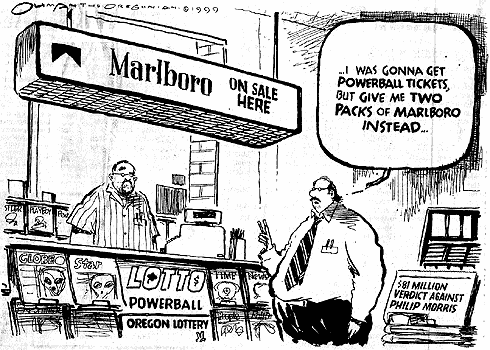 Pubdate: Thu, Apr 01 1999
Source: Oregonian, The (OR)
Copyright: 1999 The Oregonian
Contact:
letters@news.oregonian.com
Address: 1320 SW Broadway
Portland, OR 97201
Fax: 503-294-4193
Website:
http://www.oregonlive.com/
Forum:
http://forums.oregonlive.com/
Author:
Katy Muldoon of
The Oregonian staff
Award sets off emotional ride
* In the verdict's frenetic
aftermath, the family awarded
$80.3 million Tuesday found
relief, public outrage and their apartment ablaze
Tuesday came the verdict. Wednesday came the aftermath -- a roller-coaster
ride of emotions, a crush of media appearances and the sting of public
opinion -- for the Williams family of Northeast Portland, who find
themselves on the winning end of the nation's largest-ever verdict against a
tobacco manufacturer.
"There's a sense of relief that we did what my dad set after to do," Jesse
J. Williams Jr. said Wednesday.
A Multnomah County jury on Tuesday ordered Philip Morris Inc. to pay $80.3
million in damages to the estate of Williams' father, Jesse Williams Sr., a
longtime smoker who died of lung cancer two years ago.
While Williams' widow, Mayola Williams, made the rounds of national morning
news shows to discuss the verdict, talk radio shows in Portland buzzed
Wednesday with caustic comments from callers. Many where shocked at the
verdict and shared the tobacco company's view that Jesse Williams knew that
smoking was harmful but continued to smoke anyway. Some said he should have
had enough common sense to quit.
Those were the comments that stung Jesse Williams Jr., comments he thinks
are based on a poor understanding of the evidence presented in court.
Williams, 41 and one of the Williams' six grown children, said his father
had plenty of common sense. But he was unable to overcome his powerful
addiction to nicotine and thought that the cigarette manufacturer wouldn't
sell a harmful product.
During his illness, his son said, Williams decided to sue the company whose
product, Marlboros, he had used for 42 years. He discussed his decision with
his wife and children and spoke with attorneys. But Williams, described by
his son as "a good man, a kind person," died before lawyers could videotape
his testimony. He was 67.
His family honored Williams' wish to pursue the lawsuit. When the trial
finally started in late February, however, some had mixed feelings, Jesse
Williams Jr. said. The testimony "brought up a lot of emotions from dad's
death," he said. Some days were tougher than others; two of Williams' sons
were in court on March 17, the anniversary of their father's death, but
Mayola Williams chose to stay home that day.
Tuesday, too, was a highly emotional day for the family -- one filled with
more commotion than they ever expected. Not only did the jury return the
verdict in their favor, but also, when Mayola Williams and her daughter,
Joann Williams-Branch, returned about 8 p.m. to the Northeast Portland
apartment they share, they found it ablaze. A forced-air wall heater had
malfunctioned and started a fire in the apartment wall. Portland Fire Bureau
investigators said the fire caused $13,000 in damage to the structure and
contents.
Reflecting on the week's events, including word that Philip Morris will
appeal the verdict, Jesse Williams Jr. said Tuesday that the family didn't
know if they'll ever reap financial reward from the suit. But he said his
father would be pleased with the trial's outcome.
"I truly believe," he said, "this is going to help others wake up . . . help
others win their cases. . . . The justice system has done something good."
You can reach Katy Muldoon at 503-221-8526, or by e-mail at
katymuldoon@news.oregonian.com. Patrick O'Neill contributed to this report.
Pubdate: Thu, Apr 01 1999
Source: Oregonian, The (OR)
Copyright: 1999 The Oregonian
Contact:
letters@news.oregonian.com
Address: 1320 SW Broadway
Portland, OR 97201
Fax: 503-294-4193
Website:
http://www.oregonlive.com/
Forum:
http://forums.oregonlive.com/
Author:
Katy Muldoon of
The Oregonian staff
Award sets off emotional ride
* In the verdict's frenetic
aftermath, the family awarded
$80.3 million Tuesday found
relief, public outrage and their apartment ablaze
Tuesday came the verdict. Wednesday came the aftermath -- a roller-coaster
ride of emotions, a crush of media appearances and the sting of public
opinion -- for the Williams family of Northeast Portland, who find
themselves on the winning end of the nation's largest-ever verdict against a
tobacco manufacturer.
"There's a sense of relief that we did what my dad set after to do," Jesse
J. Williams Jr. said Wednesday.
A Multnomah County jury on Tuesday ordered Philip Morris Inc. to pay $80.3
million in damages to the estate of Williams' father, Jesse Williams Sr., a
longtime smoker who died of lung cancer two years ago.
While Williams' widow, Mayola Williams, made the rounds of national morning
news shows to discuss the verdict, talk radio shows in Portland buzzed
Wednesday with caustic comments from callers. Many where shocked at the
verdict and shared the tobacco company's view that Jesse Williams knew that
smoking was harmful but continued to smoke anyway. Some said he should have
had enough common sense to quit.
Those were the comments that stung Jesse Williams Jr., comments he thinks
are based on a poor understanding of the evidence presented in court.
Williams, 41 and one of the Williams' six grown children, said his father
had plenty of common sense. But he was unable to overcome his powerful
addiction to nicotine and thought that the cigarette manufacturer wouldn't
sell a harmful product.
During his illness, his son said, Williams decided to sue the company whose
product, Marlboros, he had used for 42 years. He discussed his decision with
his wife and children and spoke with attorneys. But Williams, described by
his son as "a good man, a kind person," died before lawyers could videotape
his testimony. He was 67.
His family honored Williams' wish to pursue the lawsuit. When the trial
finally started in late February, however, some had mixed feelings, Jesse
Williams Jr. said. The testimony "brought up a lot of emotions from dad's
death," he said. Some days were tougher than others; two of Williams' sons
were in court on March 17, the anniversary of their father's death, but
Mayola Williams chose to stay home that day.
Tuesday, too, was a highly emotional day for the family -- one filled with
more commotion than they ever expected. Not only did the jury return the
verdict in their favor, but also, when Mayola Williams and her daughter,
Joann Williams-Branch, returned about 8 p.m. to the Northeast Portland
apartment they share, they found it ablaze. A forced-air wall heater had
malfunctioned and started a fire in the apartment wall. Portland Fire Bureau
investigators said the fire caused $13,000 in damage to the structure and
contents.
Reflecting on the week's events, including word that Philip Morris will
appeal the verdict, Jesse Williams Jr. said Tuesday that the family didn't
know if they'll ever reap financial reward from the suit. But he said his
father would be pleased with the trial's outcome.
"I truly believe," he said, "this is going to help others wake up . . . help
others win their cases. . . . The justice system has done something good."
You can reach Katy Muldoon at 503-221-8526, or by e-mail at
katymuldoon@news.oregonian.com. Patrick O'Neill contributed to this report.


 to the 1999 Daily News index for March 26-April 1